 As time passes, ideas may go out of fashion or even become kind of taboo, but once in the world they never disappear completely. These days, fascist ideas including national socialist ones see an alarming revival all around the world thanks to – for the moment still – democratic movements that prudently deny their roots. Such pretended nationalistic and patriotic, but actually racist ideologies make believe that they can put the unfathomable chaos of the modern world in a clear order and especially the young are easy prey for the populist demagogues who cunningly preach them taking advantage of the growing discontent in the population over living conditions and cultural diversity. In the novel Crabwalk by en-NOBEL-ed German writer Günter Grass a journalist from Berlin retraces his own and his mother’s lives to understand how their history encouraged his son to write a Nazi blog and to kill his pretended Jewish counterpart.
Showing posts with label novellas. Show all posts
Showing posts with label novellas. Show all posts
Friday, 5 July 2019
Book Review: Crabwalk by Günter Grass
As time passes, ideas may go out of fashion or even become kind of taboo, but once in the world they never disappear completely. These days, fascist ideas including national socialist ones see an alarming revival all around the world thanks to – for the moment still – democratic movements that prudently deny their roots. Such pretended nationalistic and patriotic, but actually racist ideologies make believe that they can put the unfathomable chaos of the modern world in a clear order and especially the young are easy prey for the populist demagogues who cunningly preach them taking advantage of the growing discontent in the population over living conditions and cultural diversity. In the novel Crabwalk by en-NOBEL-ed German writer Günter Grass a journalist from Berlin retraces his own and his mother’s lives to understand how their history encouraged his son to write a Nazi blog and to kill his pretended Jewish counterpart. Friday, 15 March 2019
Book Review: Short Letter, Long Farewell by Peter Handke
 To come to terms with important events in life, notably with big changes, usually takes time even if they don’t turn upside-down the entire universe that we have known. Sometimes they can leave us at a complete loss because they put into question who we are and force us to re-evaluate our whole being to piece together a new identity. In the novella Short Letter, Long Farewell by Peter Handke a young Austrian writer has fled to the USA to recover his peace of mind after the end of his marriage to Judith. Years of life together had turned them into opponents seething with hatred to the point of trying to kill each other more than once, and yet, his fear of his ex-wife mixes with the urge to go after her. As a result, he zigzags across the country as much in flight from as in pursuit of Judith...
Friday, 15 February 2019
Book Review: The Wild Geese by Mori Ōgai
 Undeniably, the world would be a rather hostile place to live in without the written and unwritten rules that determine more or less strictly our behaviour towards each other. Society is firmly based on these codes of conduct although only their most essential parts are universal like the canon laid down in maybe seven of the Ten Commandments in the Christian Bible. Other social norms are inseparably connected to a more or less confined cultural sphere. In the Japanese classic The Wild Geese by Mori Ōgai the paths of medical student Okada and a moneylender’s beautiful young concubine called Otama cross in Tōkyo in 1880, but the unwritten rules of society prevent them from becoming more than just a regular passer-by and the resident of a house who know each other only from sight. However, as time advances their glances and greetings begin to mean more than they outwardly express…
Friday, 7 December 2018
Book Review: Monique by Luísa Coelho

It can be a big shock to realise that it’s absolutely impossible to know any person inside out, not even closest relations like a spouse, children or parents, sometimes not even ourselves. Some people have learnt well to hide their nature because they fear – often rightly – to risk their status and dignity showing the world who they really are. The more shattering it is when they finally muster up the courage to come out. After fifty years the protagonist of Monique by Luísa Coelho answers to the letter that her husband wrote when he abandoned her and their son. Because the homosexual pianist could no longer bear living a lie and thus chose to defy social conventions, he turned her well-ordered and idealistic world completely upside down overnight. The French noblewoman looks back on her sheltered youth that didn’t prepare her for suddenly being on her own.
Friday, 24 November 2017
Book Review: The Dragon Painter by Mary McNeil Fenollosa
 In a strictly patriarchal society it can be bad luck bordering on disaster for a man to grow old without a male heir to continue the family tradition, especially when it’s a glorious one. The cultural pressure can be so strong that a man resorts to steps that by modern western standards are rather drastic and strange, if not downright loathsome. Divorce or even murder and following remarriage to father a son with another, younger and presumably more fertile woman like English King Henry VIII is one way, marrying off a daughter and adopting the son-in-law is another. The latter is what the ageing protagonist of The Dragon Painter by Mary McNeil Fenollosa does in Tōkyo of the early twentieth century, when a friend of the family sends a young man from the mountains to him whose exceptional talent and commitment make him worthy to carry on the name of the famous family of painters.
Friday, 17 November 2017
Book Review: The Pigeon by Patrick Süskind
 Sometimes small events that must seem utterly trivial to everyone unconcerned can fundamentally shatter our peace of mind, above all when they break our routine and evoke without warning unpleasant associations that unleash imagination. Who has never been haunted for no good reason at all by horror scenarios of the future emerging from the depths of our souls in most vivid colours and in most frightening detail? In retrospect, we often laugh at ourselves for having allowed them to put us into a state of alarm, occasionally even panic. The protagonist of The Pigeon by Patrick Süskind almost goes crazy when he finds a solitary bird cooing in the corridor in front of the door to his bedsit on an ordinary Friday morning. The bird seems to him the portent of evil and he can’t help seeing through his mind’s eye how the fundaments of his pleasantly eventless and solitary existence crumble and give way to chaos.
Friday, 25 November 2016
Book Review: The Fig Tree by Françoise Xénakis
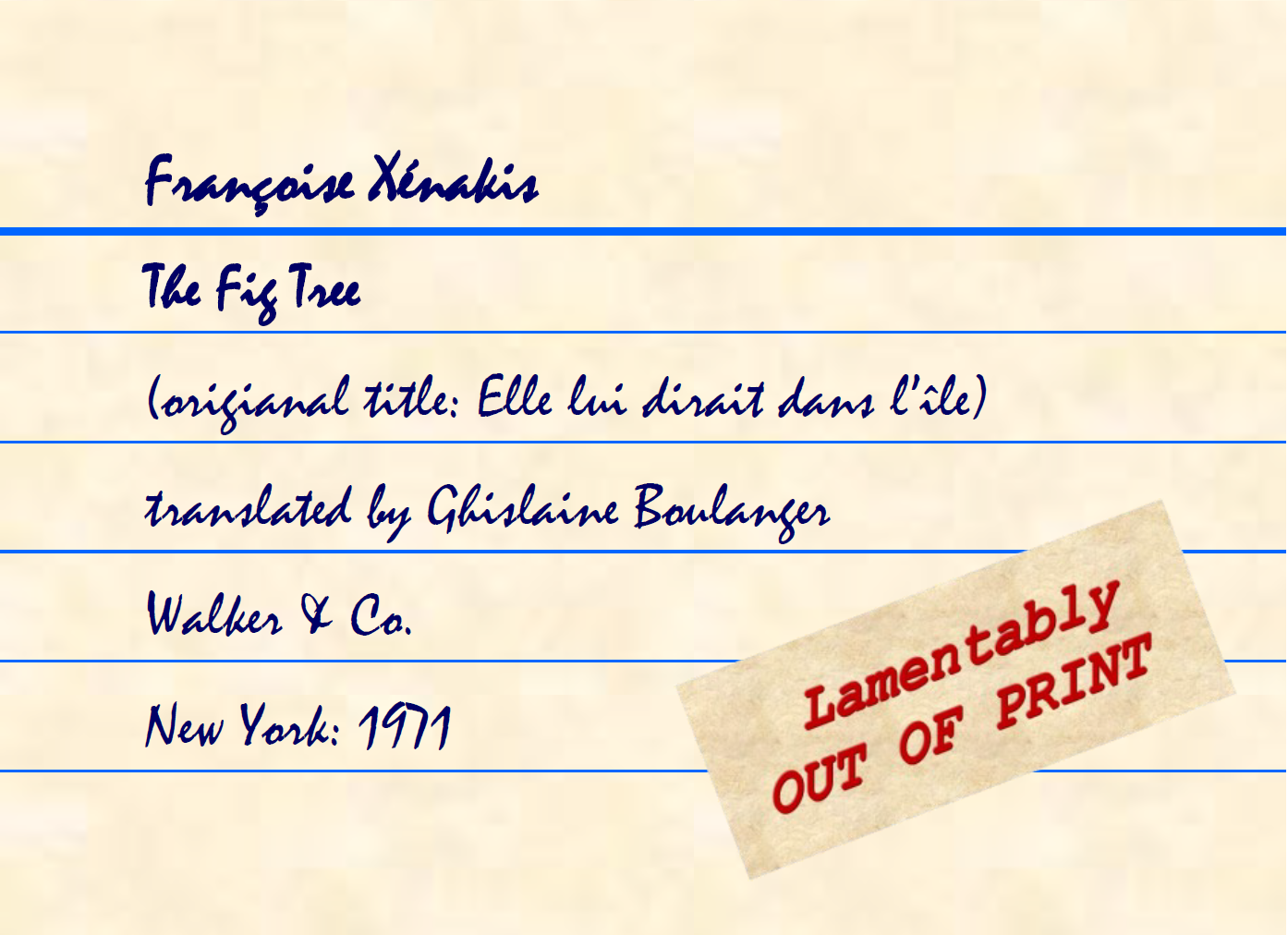 |
| Click on the index card to enlarge it! |
by an author whose family name starts with the letter
A B C D E F G H I J K L M N O P Q R S T U V W X Y Z
The character of a person is never static because it continuously adapts to outside influences and (sometimes uncommon) emotional reactions to them. Such changes of attitude and behaviour use to be gradual and therefore often remain unnoticed by oneself and the immediate surroundings even when they are quite fundamental. Harsh living conditions like during an economic crisis, under a terror regime or in a war can accelerate the process and thus turn closest friends or even lovers into complete strangers if they are separated for a while. This is the experience that the two nameless protagonists of The Fig Tree by Françoise Xénakis make. They were a happy couple full of love for each other, but a highly bureaucratic terror regime tore them from each other and kept them apart for three years. During this time he went through the unspeakable horrors of a brutally run forced labour camp and she had to cope with the humiliating routines of red tape.
Friday, 25 March 2016
Book Review: Abel Sanchez and Other Stories by Miguel de Unamuno

2016 review of a book written
by an author whose family name starts with the letter
A B C D E F G H I J K L M N O P Q R S T U V W X Y Z
It is often said that life is suffering and this is certainly true because our bodies are vulnerable, not to say mortal, and our minds use to be overflowing with desires, many of them such that can never be fulfilled. Pain is the inevitable consequence, but the big question is how we cope with it. At the heart of all three works assembled in Abel Sanchez and Other Stories by Miguel de Unamuno are suffering souls, be it that of a man unable to stop envying his best friend Abel who is almost like a twin brother to him, be it a physician who sees that his innovative talent as a writer isn’t recognised and slowly ruins his practice, be it the charitable village priest who knows how important religion is for his people and never gets tired of preaching the Catholic creed although he himself has long ceased to believe.
Wednesday, 10 February 2016
New on Lagraziana's Kalliopeion: Letter from an Unknown Woman by Stefan Zweig
 In his time Stefan Zweig (1881-1942) was one of the most famous and most successful German-language writers, but when – despairing at the political situation in his country of origin (he was Austrian of Jewish descent) – he took his own life in Brazilian exile, he knew that he was a relic of The World of Yesterday as he had perpetuated it in his autobiography. The works of the prolific author are classics of literature today and many of them have never gone out of print here in the German-speaking world, but their English translations seem to have fallen into oblivion to be rediscovered only recently. The novella that I’m reviewing today counts among Stefan Zweig’s most important and superb ones. It’s Letter from an Unknown Woman (Brief einer Unbekannten) first published in 1922 and adapted for the screen several times, e.g. one from 1948 directed by Max Ophüls.
Friday, 18 December 2015
Book Review: So You Don't Get Lost in the Neighbourhood by Patrick Modiano
 The workings of the mind are mysterious and our memory isn’t always very reliable, especially about childhood. Some people recall their early years vividly and in great detail, while others seem to remember hardly anything. Moreover, the bits and pieces that have lasted in our minds for many years often turn out to be shockingly incomplete, blurred or even alienated past the recognition of others who were present too. Some memories are so painful that they are downright repressed: access denied until… This is the experience that an ageing novelist makes in So You Don't Get Lost in the Neighbourhood by Patrick Modiano, winner of the Nobel Prize in Literature 2014. When a man steps into his life to return his lost address book, he rouses the ghosts of childhood asking after a person whose long outdated number is in it.
Friday, 13 November 2015
Book Review: The Bluest Eye by Toni Morrison
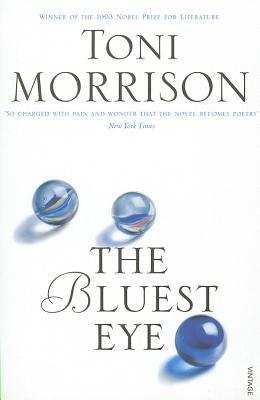 Although many tried to establish objective criteria for beauty, the wisdom that “beauty is in the eyes of the beholder” could never be defeated. Nonetheless, it would be too easy to leave it at beauty being a matter of personal taste because from the moment we are born we are exposed to the opinion of others and we can’t help internalising their standards. In Europe the ideal of a beautiful body often tends to be Nordic, i.e. since Roman times or even longer, fair skin, blond hair and blue eyes have a particular appeal to beholders. European discoverers and settlers carried this idea of human beauty into the New World and so the African American protagonist of The Bluest Eye by Toni Morrison learnt early to despise herself for her looks. She prays to God for blue eyes that will make her beautiful and happy, but of course, that’s not how it works.
 Friday, 6 November 2015
Book Review: The Loved One by Evelyn Waugh
 For Catholics this month started with two days dedicated to the commemoration of the dead, namely All Saints’ Day and All Souls’ Day. Not just during times of mourning, but also on Memorial Days, a special place to remember those who left for good can be a great consolation. Thus the habit of most civilisations to build cemeteries that, following regional, cultural and religious traditions, can be very different. They can be humble sites of recollection as well as pompous testimonials of wealth and glory both of those departed and of those bereaved. Americans in particular seem to like to “celebrate” the recently deceased in grand style and this gives morticians an important role in the funeral rites. The satirical novella The Loved One by Evelyn Waugh sets a love story against the backdrop of burials and cremations in two park-like cemeteries in Hollywood, one for humans and one for their pets.
 Friday, 23 October 2015
Book Review: Of Love and Other Demons by Gabriel García Márquez

Love is a very powerful emotion that can overwhelm even the strongest and most disciplined character, especially when it comes by surprise and for the first time. Love always feels like magic, but sometimes it appears to the outsider as if a potent spell has been cast on the lovers or only one of them. When the passion is so strong that it becomes harmful and destructive to the people concerned, it isn’t a long way to think that a demon must be at work. This is what happens in the historical novel Of Love and Other Demons by Gabriel García Márquez set in a time when and a place where superstition was common. It tells a story of first love under particularly unfavourable circumstances and between a most unlikely couple, namely between a scarcely adolescent girl alleged of being possessed by demons and her already middle-aged exorcist in an eighteenth-century sea town somewhere in South America.
Friday, 2 October 2015
Book Review: The Happy Foreigner by Enid Bagnold
 A scene of war is a scaring and depressing place. Often no house remains intact, no field safely arable and it seems impossible that the old hustle and bustle of life can ever return. These days we see it in Syria and other regions less present in the media, but not so long ago great parts of Europe were in ruins. Certain areas of France and Belgium were destroyed twice within less than half a century! Today many of the battlefields – what a harmless sounding word compared to German “Schlachtfeld” that has slaughter in it! – are well-kept places of remembrance, while they were nothing but craters and rubble right after World War I and II. The English novel The Happy Foreigner by Enid Bagnold evokes the atmosphere of winter 1918/19, the first of peace after four years of carnage, through the eyes of a young woman driver in the service of the French army.
 Friday, 11 September 2015
Book Review: Breakfast at Tiffany's by Truman Capote
 There are books that everybody has at least heard of and that keep attracting readers throughout years, decades and in some cases even centuries, in short books that are timeless classics of literature. Undeniably, the slim volume that I picked for today’s review is such a classic or to be precise a modern classic since it first appeared only in 1958. I admit that Breakfast at Tiffany's by Truman Capote may owe part of its lasting notoriety and popularity to the fact that it was adapted for the screen as early as in 1961 starring Audrey Hepburn. For the rest, the novella is a brilliant portrait of a young woman who left behind a modest life somewhere at the back of beyond in order to enter well-to-do society of New York City and to get her share of glamour and happiness.
Friday, 1 May 2015
Book Review: Lyric Novella by Annemarie Schwarzenbach

Thinking of Switzerland literature certainly isn’t the first thing that comes to mind because in this context language is more important than nationality and therefore the country’s bigger neighbours France, Italy… and Germany reap many of the laurels. Nonetheless there is a thriving community of German-language writers in Switzerland and probably there always was although among Swiss authors published before 1939 I could name only four until recently: Johanna Spyri, C. F. Meyer, Carl Spitteler, and Hermann Hesse. With today’s review I’m putting the spotlight on the work of a fifth, of a woman writer. Lyric Novella by Annemarie Schwarzenbach is the sentimental story of a nameless narrator’s obsession for the cabaret singer Sibylle set in the thriving theatre scene of 1930s Berlin as it is known from the musical Cabaret.
Friday, 10 April 2015
Book Review: The Return of the Caravels by António Lobo Antunes
 This week I was in the mood for Portuguese literature and decided to review a book by António Lobo Antunes. My first choice was Tratado das Paixões da Alma (Treatise on the Passions of the Soul), but as so often I was annoyed to find that it hasn’t been translated into English. Easter just past (or ahead in the Orthodox Christian Churches) it would have felt odd to talk about a book half set on Christmas Eve, so I ruled out The Splendor of Portugal. At last I turned towards The Return of the Caravels by António Lobo Antunes which offers a delirious fusion of Portugal’s rise to and fall as a colonial power between the sixteenth century and 1974. The seedy old colonists who return to Lisbon after many decades away are at the same time the former discoverers and great names of Portuguese history.
Friday, 3 April 2015
Book Review: Mr. Fortune's Maggot by Sylvia Townsend Warner

Today is Good Friday and I thought that this might be the right moment to feature kind of a Christian read. The protagonist of the novel that I picked for my review is an Protestant missionary on a remote islet in the South Seas, but the plot revolves less around religion than it is about love and the harm that the influence of western civilisation can do, especially in combination with the belief in its supremacy. The topic undoubtedly is a serious one, and yet Mr. Fortune’s Maggot by Sylvia Townsend Warner isn’t a stern book at all. It’s a satire of missionary zeal to convert the savage to true faith and western life-style. The novel is set before the Great War of 1914-18 when there still were untouched spots on our planet, thus long before the world had shrunk to the size of a computer screen.
Friday, 12 December 2014
Book Review: The Winter of Artifice by Anaïs Nin
 Originally, I intended to close my cycle of reviews for the Books on France 2014 reading challenge only in two weeks with the novel Voyage d’hiver by Amélie Nothomb, but unfortunately it seems that this work of the Belgian author – unlike most others – hasn’t been translated into English yet. As a result, I had to change my plans and look for another France-related book with the word WINTER in the title (»»» see my post on the current special). In the end I picked a collection of three novellas of which two are set in France: The Winter of Artifice by Anaïs Nin, namely the original published in Paris in 1939 which is available as a facsimile edition. The author wrote her diary-style stories revolving around love and passion in English although her mother tongue was French.
Friday, 11 July 2014
Book Review: The Mussel Feast by Birgit Vanderbeke
 Past Sunday (6 July 2014) the writer and cartoonist Tex Rubinowitz received this year’s Ingeborg Bachmann Prize in Klagenfurt, Austria. Since it’s the most prestigious literary award for German-language writers, it occurred to me that it might be a good idea to review today the work of one of the thirty-seven previous laureates. As luck would have it, The Mussel Feast by Birgit Vanderbeke has just recently been translated into English for the first time and shortlisted for the Independent Foreign Fiction Prize. Almost a quarter of a century ago (sic!) an extract from the very same narrative about the repressed anger of a family ruled by a tyrannical father earned the author the Ingeborg Bachmann Prize.
Birgit Vanderbeke was born in Dahme, Brandenburg, German Democratic Republic, in August 1956. As from 1961 she grew up in Frankfurt am Main, Federal Republic of Germany, where she later studied law, Germanic and Romance philology. Reading from her narrative The Mussel Feast (Das Muschelessen) she won the Ingeborg Bachmann Prize 1990 which marked her literary breakthrough. None of the author’s other works, most notable among them Ich will meinen Mord (1995; I Want My Murder), Alberta empfängt einen Liebhaber (1997; Alberta Receives a Lover) and Geld oder Leben (2003; Money or Life), have been translated into English yet. Her latest published work is Der Sommer der Wildschweine (2013; The Summer of the Wild Boars). Birgit Vanderbeke lives in Southern France.
The main plot of The Mussel Feast is set in Western Germany some time during the 1970s. Waiting for the father’s return from an official trip which is expected to have led to the longed-for promotion, the eighteen-year-old narrator sits in the kitchen with her mother and younger brother. In anticipation of the good news the mother has prepared mussels which are the father’s favourite dish ever since he fled with his wife and baby daughter from East Germany shortly before the Berlin Wall was erected in 1961. None of the others cares for mussels – the two women even find them disgusting –, but everything in this family is done according to the father’s rules and (presumed) wishes because otherwise they would have to suffer the humiliating, often violent consequences. He is a tyrant with very precise ideas of how a proper family works and how a perfect wife and the perfect children should be. He’s always right and everybody else is automatically at fault. Of course, reality never corresponds with the idyll in his mind and every so often he interrogates and punishes wife, daughter and son. At every opportunity he makes them feel his disappointment. He is obsessed also with social status to the point of living beyond the family’s means. Mother and children have learnt to play their roles and to live their own ideas of life outside his sphere when there’s no risk to be discovered. As the evening advances and the usual routine is broken because the father doesn’t arrive for dinner at six as expected, the three help themselves to some wine and before long they get slightly drunk. Their repressed anger drifts to the surface.
Superficially The Mussel Feast looks like a first-person narrative about a family falling short of the all-controlling father’s distorted ideal, but in reality it’s the story of people living in a tyrannical system of any kind. The dysfunctional family assembled around the kitchen table is at the same time a small-scale model of a dictatorial state like the German Democratic Republic between 1949 and 1990. Characteristic of both social entities is a climate of constant fear and distrust. Also the strategies of oppressor and oppressed are the same: the first rules with an iron fist to crush opposition against the proclaimed only truth as well as to sap self-confidence and the latter take on a habit of servility while secretly indulging in unwanted or even prohibited activities and behaviour. At the end the pressure gets too strong and emotions boil over in a revolution. History proved more than once that sooner or later the human urge for freedom of thought always succeeds in overthrowing a repressive system! Birgit Vanderbeke’s book is a slim volume of scarcely more than a hundred pages even in German, certainly less in English translation. There are no chapters and in addition the text is divided by only few paragraphs composed of long, involved periods which require a bit of concentration in order not to lose the thread. The language used by the author is colloquial in general and appropriate for the eighteen-year-old narrator. Everything, including dialogues, is narrated.
All in all, The Mussel Feast by Birgit Vanderbeke is an absorbing read which reveals a lot about the mechanisms of tyranny and the abysses behind the façade of a proper family. Unfortunately, there are fathers like the one portrayed in this novella in reality… and even worse brutes (men and women) who bring up children and keep the vicious circle of violence and abuse going behind the well-protected walls of home. The novella no light read, but one that makes think. Therefore I’m more than willing to recommend it.
To know more about the Austrian author in whose honour is awarded the leading prize for German-language literature »»» read my portrait of Ingeborg Bachmann.
The main plot of The Mussel Feast is set in Western Germany some time during the 1970s. Waiting for the father’s return from an official trip which is expected to have led to the longed-for promotion, the eighteen-year-old narrator sits in the kitchen with her mother and younger brother. In anticipation of the good news the mother has prepared mussels which are the father’s favourite dish ever since he fled with his wife and baby daughter from East Germany shortly before the Berlin Wall was erected in 1961. None of the others cares for mussels – the two women even find them disgusting –, but everything in this family is done according to the father’s rules and (presumed) wishes because otherwise they would have to suffer the humiliating, often violent consequences. He is a tyrant with very precise ideas of how a proper family works and how a perfect wife and the perfect children should be. He’s always right and everybody else is automatically at fault. Of course, reality never corresponds with the idyll in his mind and every so often he interrogates and punishes wife, daughter and son. At every opportunity he makes them feel his disappointment. He is obsessed also with social status to the point of living beyond the family’s means. Mother and children have learnt to play their roles and to live their own ideas of life outside his sphere when there’s no risk to be discovered. As the evening advances and the usual routine is broken because the father doesn’t arrive for dinner at six as expected, the three help themselves to some wine and before long they get slightly drunk. Their repressed anger drifts to the surface.
Superficially The Mussel Feast looks like a first-person narrative about a family falling short of the all-controlling father’s distorted ideal, but in reality it’s the story of people living in a tyrannical system of any kind. The dysfunctional family assembled around the kitchen table is at the same time a small-scale model of a dictatorial state like the German Democratic Republic between 1949 and 1990. Characteristic of both social entities is a climate of constant fear and distrust. Also the strategies of oppressor and oppressed are the same: the first rules with an iron fist to crush opposition against the proclaimed only truth as well as to sap self-confidence and the latter take on a habit of servility while secretly indulging in unwanted or even prohibited activities and behaviour. At the end the pressure gets too strong and emotions boil over in a revolution. History proved more than once that sooner or later the human urge for freedom of thought always succeeds in overthrowing a repressive system! Birgit Vanderbeke’s book is a slim volume of scarcely more than a hundred pages even in German, certainly less in English translation. There are no chapters and in addition the text is divided by only few paragraphs composed of long, involved periods which require a bit of concentration in order not to lose the thread. The language used by the author is colloquial in general and appropriate for the eighteen-year-old narrator. Everything, including dialogues, is narrated.
All in all, The Mussel Feast by Birgit Vanderbeke is an absorbing read which reveals a lot about the mechanisms of tyranny and the abysses behind the façade of a proper family. Unfortunately, there are fathers like the one portrayed in this novella in reality… and even worse brutes (men and women) who bring up children and keep the vicious circle of violence and abuse going behind the well-protected walls of home. The novella no light read, but one that makes think. Therefore I’m more than willing to recommend it.
To know more about the Austrian author in whose honour is awarded the leading prize for German-language literature »»» read my portrait of Ingeborg Bachmann.
Subscribe to:
Posts (Atom)