 However much we’d like to start life all over again with a clean slate after a traumatising experience, it’s virtually impossible. If we like it or not, any such experience has a lasting impact on our world view and on our behaviour as well. It marks and even forms us. Cases of dementia and brain injury excluded, we can only refuse to allow memories to come back to our conscious minds. Nonetheless, they keep working on us under the surface. And more often than not, these disagreeable ghosts of the past return sooner or later to haunt us. Ten years after his flight, the exiled playwright in One Man’s Bible by Gao Xinjian, the Sino-French recipient of the Nobel Prize in Literature 2000, finds himself forced to relive the trauma of almost fifty years under Communist reign that he tried to forget when his Jewish-German sex partner starts asking questions.
Showing posts with label French literature. Show all posts
Showing posts with label French literature. Show all posts
Friday, 20 December 2019
Book Review: One Man’s Bible by Gao Xingjian
However much we’d like to start life all over again with a clean slate after a traumatising experience, it’s virtually impossible. If we like it or not, any such experience has a lasting impact on our world view and on our behaviour as well. It marks and even forms us. Cases of dementia and brain injury excluded, we can only refuse to allow memories to come back to our conscious minds. Nonetheless, they keep working on us under the surface. And more often than not, these disagreeable ghosts of the past return sooner or later to haunt us. Ten years after his flight, the exiled playwright in One Man’s Bible by Gao Xinjian, the Sino-French recipient of the Nobel Prize in Literature 2000, finds himself forced to relive the trauma of almost fifty years under Communist reign that he tried to forget when his Jewish-German sex partner starts asking questions.Friday, 21 June 2019
Book Review: Portrait of a Man Unknown by Nathalie Sarraute
 Not only political power can bring the despotic vein of a person to the surface. In fact, most of us will be a lot more familiar with it from a family setting where it shows more or less markedly in relations with children or less self-assured relatives, notably a weak spouse. This wish to rule over others, to impose our will on them seems to be deeply rooted in our nature. In addition, living it we often pass it on to the next generations. The father in Portrait of a Man Unknown by Nathalie Sarraute is tough to his grown-up daughter whose penchant for a carefree and extravagant life he disapproves because he had to work very hard to live in moderate wealth. He even threw her out of his flat to teach her a lesson, but she always comes back to him for money that he grudgingly gives her…
 Friday, 26 October 2018
Book Review: Vipers’ Tangle by François Mauriac
 Exclusion happens every day and even in the family as the most intimate social group. Often it results from misunderstandings that nobody cared to clear up out of pride, shame or simply lack of concern and that were thus allowed to grow without measure. As time passes, the excluded may try to compensate the estrangement from the group or/and develop bitter feelings towards the others. It’s how the protagonist of Vipers’ Tangle by François Mauriac, who was awarded the 1952 Nobel Prize in Literature, became a rancorous miser expecting the worst from his surrounding. Feeling death approach, he decides to put into writing all the exasperation at his family’s indifference and selfishness that he bottled up for decades. He sets out to write a pungent letter to his wife, but as he advances he gradually understands that he added his own to getting estranged from his family and everybody else.
 Friday, 15 December 2017
Book Review: The Trolley by Claude Simon
 For me it’s ever again amazing to see how vividly some people remember their childhoods even many decades later. Of course, everybody knows forceful experiences, good and bad, that seem to be burnt inerasably into our minds, while others simply fade with time until there seems to be no trace left of them in our memories. At certain times, notably at family reunions of any kind, some of us like to evoke the past and at other times, the recollections come just over us if we like it or not. The latter is what happens in The Trolley by Claude Simon who received the Nobel Prize in Literature in 1985. At the age of 88 years the author and narrator finds himself in the emergency unit of the hospital and he remembers his school days in Perpignan commuting every day on the trolley connecting the city with the beach where he stayed with his fatally ill mother.
 Friday, 7 July 2017
Book Review: To Arms! by Marcelle Tinayre
 War is a terrible curse, but a man-made one that its advocates and profiteers always tried to sell as necessary to protect or restore the country’s safety, strength, honour, identity, or whatever else society sees at risk. More than once wars spread to other countries because of alliances made in times of peace. World War One is only one of the most notorious examples. When Emperor Francis Joseph I. of Austria-Hungary declared war to Serbia on 28 July 1914 it was the beginning of a chain reaction turning huge parts of Europe (and the world) into ghastly battlefields for over four years. As early as in summer 1915, the novel To Arms! by Marcelle Tinayre thematised the anxiety that a dissimilar group of Parisians lived in the last hours before France was drawn into the war and first soldiers left their families to move into their barracks.
Friday, 24 March 2017
Book Review: The Roots of Heaven by Romain Gary

Friday, 25 November 2016
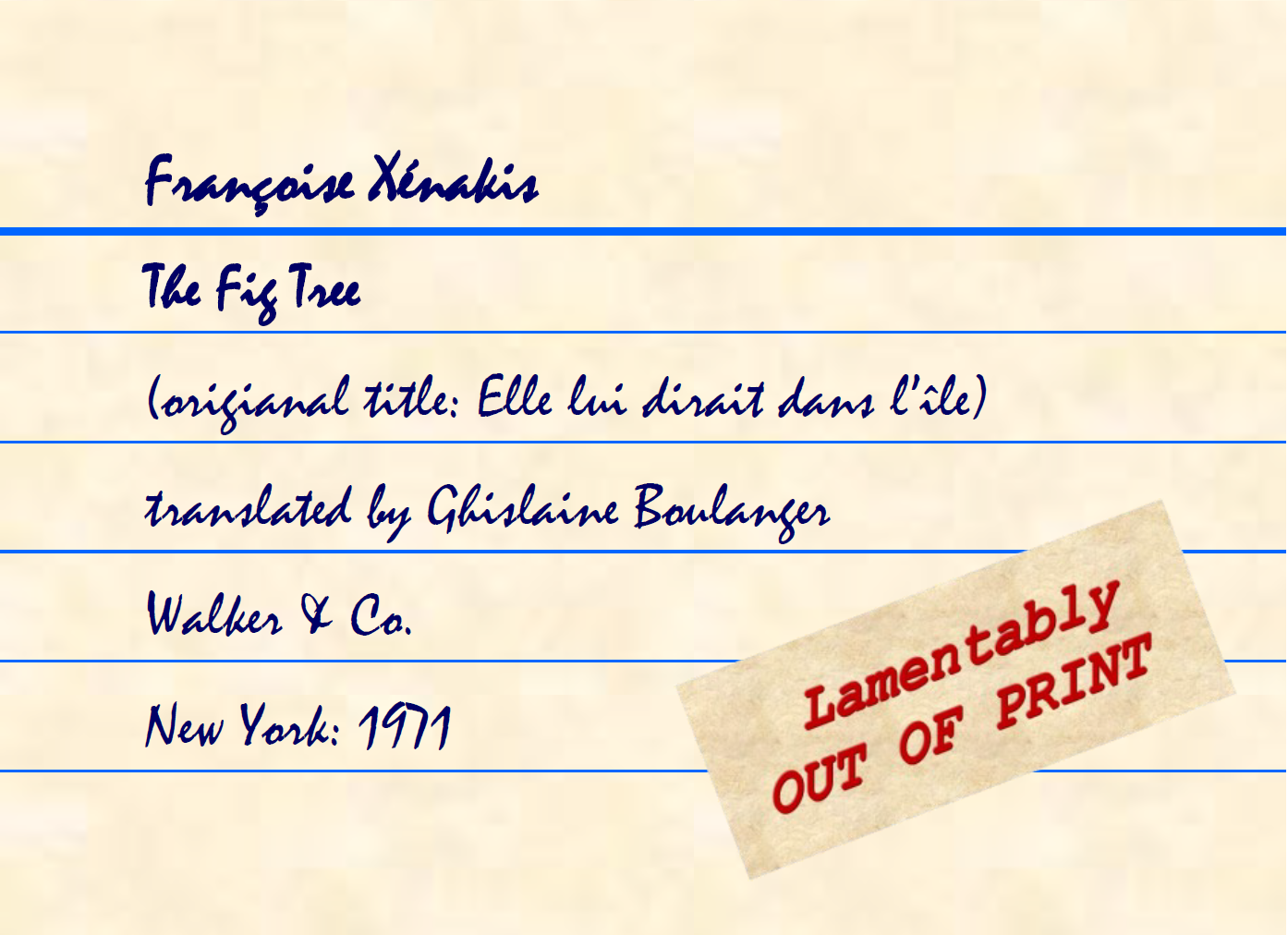
Book Review: The Fig Tree by Françoise Xénakis
 |
| Click on the index card to enlarge it! |
by an author whose family name starts with the letter
A B C D E F G H I J K L M N O P Q R S T U V W X Y Z
The character of a person is never static because it continuously adapts to outside influences and (sometimes uncommon) emotional reactions to them. Such changes of attitude and behaviour use to be gradual and therefore often remain unnoticed by oneself and the immediate surroundings even when they are quite fundamental. Harsh living conditions like during an economic crisis, under a terror regime or in a war can accelerate the process and thus turn closest friends or even lovers into complete strangers if they are separated for a while. This is the experience that the two nameless protagonists of The Fig Tree by Françoise Xénakis make. They were a happy couple full of love for each other, but a highly bureaucratic terror regime tore them from each other and kept them apart for three years. During this time he went through the unspeakable horrors of a brutally run forced labour camp and she had to cope with the humiliating routines of red tape.
Wednesday, 12 October 2016
New on Lagraziana's Kalliopeion: Ravel. A Novel by Jean Echenoz
 The Decomposition of a Musical Brain:
Ravel. A Novel by Jean Echenoz
There are melodies so unique that it’s enough to hear their first notes to know what is coming. Without doubt the Boléro by Maurice Ravel (1875-1937) is such a memorable piece of music. Although it’s a classical orchestra tune and not actually new – it premiered as a ballet in November 1928 –, virtually everybody knows it at least partly; most people will even remember the name of its French composer notwithstanding that they may never have heard any other work of his. After all, Ravel was celebrated already during his lifetime and his fame hasn’t faded since his tragic death following the desperate attempt to stop or even reverse his mental decline with brain surgery. But what kind of a man was Maurice Ravel apart from his compositions? In his short critically acclaimed biographical novel Ravel, which first appeared early in 2006, the French author Jean Echenoz evokes the last decade in the life of the musical genius starting with his 1928 grand tour of America.
Read more » (external link to Lagraziana's Kalliopeion)
Friday, 23 September 2016
Book Review: Submission by Michel Houellebecq
 2016 review of a book written
by an author whose family name starts with the letter
A B C D E F G H I J K L M N O P Q R S T U V W X Y Z
With refugees from Muslim countries streaming to Europe without end and too often without permission too, we’re living turbulent times that put politics and even democracy altogether to a hard test. Moreover, recurring terrorist attacks kindle increasingly negative feelings towards our Muslim neighbours, be they foreigners or citizens. Calls of the extreme right not to allow in any more foreigners (and even to throw out those who are here already) are growing louder every day and the number of people sharing their opinion is likewise growing as prove the results of their parties in elections virtually everywhere around. However, the times of ethnically homogeneous nations – if they ever existed at all! – are long over. Muslims are part of European society and begin to take responsibility on a political level too. With a professor of French literature as a protagonist, the 2015 novel Submission by Michel Houellebecq shows where the development could lead by 2022.
Friday, 8 July 2016
Book Review: Five Women on a Galley by Suzanne Normand
 |
| Click on the index card to enlarge it! |
by an author whose family name starts with the letter
A B C D E F G H I J K L M N O P Q R S T U V W X Y Z
The years following the Great War of 1914-18 were a difficult time, not least for women who were forced or wished to earn their own living. During the war many of them worked because most men were away on the battlefields of Europe and somebody had to do their jobs. After the war those men who had survived returned and reclaimed their jobs pushing women back into the roles of wives and mothers. But above all among the young generation there were women who refused to be confined to kitchen, children and church as before. Society made them pay dearly for their freedom as shows the semi-autobiographical novel Five Women on a Galley by Suzanne Normand that is almost completely forgotten today. Set in Paris in the first half of the 1920s – which qualifies it for Paris in July hosted by Thyme for Tea – it surrounds five friends striving for independence and happiness.
Friday, 20 May 2016
Book Review: The Blue Flowers by Raymond Queneau

2016 review of a book written
by an author whose family name starts with the letter
A B C D E F G H I J K L M N O P Q R S T U V W X Y Z
Sometimes dream and reality can be quite difficult to distinguish one from another, and as a matter of fact, ancient cultures often didn’t as we do today. The idea that life is nothing but a dream is rather old too. Philosophers have been discussing the matter for many centuries… and writers too have been attracted to it as proves literary history. The 1965 novel The Blue Flowers by French author Raymond Queneau is a particularly clear and important example for it, one with a decidedly surrealistic touch. In it not only present and past but also dream and reality merge in a way that makes it impossible to tell which is which. There is Cidrolin who lives in Paris in 1964 and there is the Duke of Auge who starts his journey through French history in 1264 leaping towards the present in steps of exactly 175 years. Their weird dreams link them through time and eventually bring them together.
Wednesday, 9 March 2016
New on Lagraziana's Kalliopeion: A Woman’s Story by Annie Ernaux
 There will be very few who deny that the mother has a very special place in the heart of a person and that when she dies, it uses to be a particularly painful loss in most cases even if she has been suffering for a long time. It means the irrevocable end of an era – of “childhood” in a wide sense – since even the last remaining bond is cut and we can no longer submit like a child to her loving care if we feel like it. After the death of her mother, the renowned French author of autobiographical prose Annie Ernaux (born 1940) set out to trace the course of life of the woman who brought her into life and raised her. The result is A Woman’s Story first published in 1989, a touching literary portrait of a strong and powerful woman who was more than just the author’s mother.
Read more (external link) »
related content on this blog:
»»» Book Review: A Man’s Place by Annie Ernaux
related content on this blog:
»»» Book Review: A Man’s Place by Annie Ernaux
Friday, 4 March 2016
Book Review: A Man's Place by Annie Ernaux

2016 review of a book written
by an author whose family name starts with the letter
A B C D E F G H I J K L M N O P Q R S T U V W X Y Z
No matter when it comes, if out of the blue or dragging on painfully, the death of a dear parent almost always arrives too soon and is the source of great grief. Those who are left behind follow very different strategies to cope with the loss… and writing about the departed is one of them. Without doubt the greater part of such works of sorrow ends unread, maybe even forgotten somewhere on the bottom of a drawer, not so the award-winning French book titled A Man’s Place by Annie Ernaux, the author's literary homage to her late father written more than ten years after his death. In it she resurrects her relationship with the man who was her father and who never really managed to shake off his humble origins as the son of an illiterate farm labourer in Normandy although together with his wife he started a small café and grocery shop.
Friday, 18 December 2015
Book Review: So You Don't Get Lost in the Neighbourhood by Patrick Modiano
 The workings of the mind are mysterious and our memory isn’t always very reliable, especially about childhood. Some people recall their early years vividly and in great detail, while others seem to remember hardly anything. Moreover, the bits and pieces that have lasted in our minds for many years often turn out to be shockingly incomplete, blurred or even alienated past the recognition of others who were present too. Some memories are so painful that they are downright repressed: access denied until… This is the experience that an ageing novelist makes in So You Don't Get Lost in the Neighbourhood by Patrick Modiano, winner of the Nobel Prize in Literature 2014. When a man steps into his life to return his lost address book, he rouses the ghosts of childhood asking after a person whose long outdated number is in it.
Friday, 22 May 2015
Book Review: Penguin Island by Anatole France
 We humans are a strange lot. We are proud of our history although it tells of so many wars that there probably are only very few places in Europe that can boast with NOT having been a battlefield at one time or another. We highly appreciate virtue and cast it into elaborate forms like social conventions and religion, and yet, we seem to have inherited a rather vicious vein which strikes through ever again and results in incredible atrocities. The history of Penguin Island by Anatole France holds the mirror up to us showing plainly and in a rather cynical tone how our modern society was to became what it is and where it might lead us in the future.
Friday, 12 December 2014
Book Review: The Winter of Artifice by Anaïs Nin
 Originally, I intended to close my cycle of reviews for the Books on France 2014 reading challenge only in two weeks with the novel Voyage d’hiver by Amélie Nothomb, but unfortunately it seems that this work of the Belgian author – unlike most others – hasn’t been translated into English yet. As a result, I had to change my plans and look for another France-related book with the word WINTER in the title (»»» see my post on the current special). In the end I picked a collection of three novellas of which two are set in France: The Winter of Artifice by Anaïs Nin, namely the original published in Paris in 1939 which is available as a facsimile edition. The author wrote her diary-style stories revolving around love and passion in English although her mother tongue was French.
Friday, 5 December 2014
Book Review: A Monkey in Winter by Antoine Blondin
 |
| Click on the index card to enlarge it! |
Friday, 7 November 2014
Book Review: Journey to the End of the Night by Louis-Ferdinand Céline
 The World War of 1914-18 brought not only radical changes regarding borders, governments and relations between countries, but it also had a lasting impact on people and society. An important, though controversial novel that shows how the war shadowed life and attitude of two average French combatants, and that I’m reviewing today for both the Books on France 2014 Reading Challenge and The Great War in Literature Special, is Journey to the End of the Night by Louis-Ferdinand Céline. The plot begins with the belligerent atmosphere before the war which led the French army into incredibly atrocious battles in Belgium. The narrating protagonist survives, but carrying the burden of what he has witnessed and participated in his soul remains in the gloom of a never-ending night.
Friday, 17 October 2014
Book Review: Marie Claire by Marguerite Audoux
 About one week ago the French writer Patrick Modiano was announced as this year’s winner of the Nobel Prize in Literature (»»» read the respective announcement on Read the Nobels), but quite apart from the fact that I had never heard of him until then, I would consider it too early and too obvious to review one of his books for the Books on France 2014 reading challenge already today. Instead I chose a bestselling novel from the early twentieth century, more precisely a memoir: Marie Claire by Marguerite Audoux. The author was already forty-seven years old when this masterpiece of hers, in which she recounts her childhood and adolescence in a Catholic orphanage and on a remote French farm, came out and earned her the Prix Femina 1910.
Friday, 26 September 2014
Book Review: I'm Off by Jean Echenoz
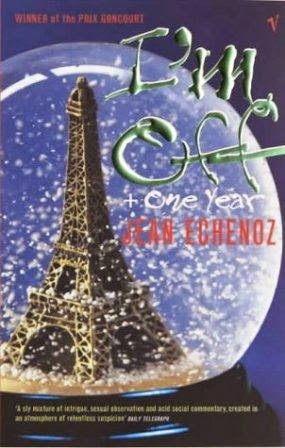
Art business is tough. Tastes change at the same pace as fashion and buyers always ask for something new at a good price, something that will increase its value with time and that will give the owner the aura of a true connoisseur. Who wants to earn a fortune selling art thus needs to be either some kind of a clairvoyant or a genius in sales or a trendsetter of renown. The lady-killing protagonist of I'm Off by Jean Echenoz, which I'm reviewing for the Books on France 2014 reading challenge, is the owner of a small art gallery in Paris who doesn’t spare costs nor pains to secure priceless objects for his clients almost from North Pole when his assistant baits him with the profits. Then the whole lot is stolen and it seems the end of all dreams, even of the protagonist’s life, but things are never so bad as they look at first.
Jean Echenoz was born in Orange, Southern France, in December 1947. He studied sociology and civil engineering at different French universities. He made his literary debut with Le méridien de Greenwich (The Greenwich Meridian) in 1979 which was followed by the prize-winning novel Cherokee (1983). Many works of this prolific French author have been translated into English, most notable among them Chopin’s Move (Lac: 1989), I’m Off (Je m’en vais: 1999; also translated as I’m Gone), Ravel (2006), Running (Courir: 2008), Lightning (Des éclairs: 2010), and the World War I novel 1914 (14: 2012). Jean Echenoz lives in Paris, France.
With the title words I'm Off the Parisian gallery owner Félix Ferrer leaves his wife Suzanne on Sunday, 3 January. He is a womaniser in his mid-fifties and longing for a change, but he is despite all surprised that Suzanne doesn’t even bother to make a scene. For a couple of months he lives with his young lover Laurence, until she throws him out. Then Ferrer moves into a luxurious apartment in the rue d’Amsterdam where his assistant Delahaye shows up one night with his friend Victoire (who settles down there for a while). Business in the gallery has been slack already for a while and Delahaye seizes the opportunity to talk to Ferrer about a small commercial ship called Nechilik that got stuck in the Arctic ice in 1957 and was recently rediscovered. Among the frozen cargo is Inuit art which happens to be sought for by collectors and seems such a good bargain to Ferrer that he decides to travel to northwesternmost Canada to secure it for his gallery. Before the adventure can begin, Delahaye is victim of a fatal accident. At least that’s what Ferrer and the rest of the world is made believe, while in reality he has taken on the name Baumgartner and waits for the moment to score the prepared big coup. On a day in June Ferrer boards a plane to Montreal and continues the strenuous travel to the remote coast of the District of Mackenzie (Nunavut Territory since 1999) first on an icebreaker and then on dogsled. Even in the isolation of the Arctic he finds women to seduce, the nurse-librarian of the icebreaker and an Inuit girl. The artefacts from the Nechilik meet all his expectations and he takes them back with him to his gallery in Paris. Before he has a chance to even insure his treasure, it is stolen by the junkie thief Le Flétan who was hired by Delahaye, now Baumgartner. For Ferrer the loss is a disaster, since he put almost all his money and hopes into the acquisition. He calls at every bank to get a loan, but his errands are in vain and eventually it is too much for his already weak heart. His life, however, goes on after a multiple heart bypass and it still has some surprises as well as charming women in store for him.
The novel I'm Off is told from the perspective of an all-knowing narrator who doesn’t hesitate to insert his own (sometimes laconic) comments on described events and actions in the plot whenever he considers it necessary or useful. It’s obvious that the main two story lines – Ferrer’s expedition beyond the Arctic Circle to secure the Inuit artefacts and everything concerning their following theft – combine the popular genres of adventure and crime with a character study of the protagonist, a womaniser going through a midlife crisis. Jean Echenoz spiced his novel with a good dash of irony, though, making fun of the established rules of fiction writing which keep being observed above all by authors who (try to) create genre bestsellers in great numbers in as little time and with as little effort as possible. A considerable number of flashbacks and flash-forwards livens up the plot which all in all feels plausible and without loose ends. Despite being caricatured to a certain degree, all characters in the book appear and act like types that can be found in any neighbourhood. With Jean Echenoz the choice of their names sometimes is a pun too, but in general they aren’t translated because otherwise the junkie thief of this novel would be called the Halibut instead of Le Flétan. In style the work of Jean Echenoz is said to evoke Raymond Queneau and Laurence Sterne. Since I haven’t read anything by either of them, I can’t tell it it’s true, though. The author’s language is modern, unpretentious and characterised by the ample use of wordplay as well as unique images which add a great deal to the pleasure of the read. I had no difficulty at all to read the original French version although some of the puns obvious to a French reader may have been lost on me.
All things considered, I'm Off by Jean Echenoz has been an entertaining and interesting cross-genre read. I liked the author’s sense of humour that shows in subtle irony rather than gross jokes and I will surely read others of his (usually) short novels. The first one will be the novella titled One Year (Un an) from 1987 that is included in the English edition that I chose for this review.
With the title words I'm Off the Parisian gallery owner Félix Ferrer leaves his wife Suzanne on Sunday, 3 January. He is a womaniser in his mid-fifties and longing for a change, but he is despite all surprised that Suzanne doesn’t even bother to make a scene. For a couple of months he lives with his young lover Laurence, until she throws him out. Then Ferrer moves into a luxurious apartment in the rue d’Amsterdam where his assistant Delahaye shows up one night with his friend Victoire (who settles down there for a while). Business in the gallery has been slack already for a while and Delahaye seizes the opportunity to talk to Ferrer about a small commercial ship called Nechilik that got stuck in the Arctic ice in 1957 and was recently rediscovered. Among the frozen cargo is Inuit art which happens to be sought for by collectors and seems such a good bargain to Ferrer that he decides to travel to northwesternmost Canada to secure it for his gallery. Before the adventure can begin, Delahaye is victim of a fatal accident. At least that’s what Ferrer and the rest of the world is made believe, while in reality he has taken on the name Baumgartner and waits for the moment to score the prepared big coup. On a day in June Ferrer boards a plane to Montreal and continues the strenuous travel to the remote coast of the District of Mackenzie (Nunavut Territory since 1999) first on an icebreaker and then on dogsled. Even in the isolation of the Arctic he finds women to seduce, the nurse-librarian of the icebreaker and an Inuit girl. The artefacts from the Nechilik meet all his expectations and he takes them back with him to his gallery in Paris. Before he has a chance to even insure his treasure, it is stolen by the junkie thief Le Flétan who was hired by Delahaye, now Baumgartner. For Ferrer the loss is a disaster, since he put almost all his money and hopes into the acquisition. He calls at every bank to get a loan, but his errands are in vain and eventually it is too much for his already weak heart. His life, however, goes on after a multiple heart bypass and it still has some surprises as well as charming women in store for him.
The novel I'm Off is told from the perspective of an all-knowing narrator who doesn’t hesitate to insert his own (sometimes laconic) comments on described events and actions in the plot whenever he considers it necessary or useful. It’s obvious that the main two story lines – Ferrer’s expedition beyond the Arctic Circle to secure the Inuit artefacts and everything concerning their following theft – combine the popular genres of adventure and crime with a character study of the protagonist, a womaniser going through a midlife crisis. Jean Echenoz spiced his novel with a good dash of irony, though, making fun of the established rules of fiction writing which keep being observed above all by authors who (try to) create genre bestsellers in great numbers in as little time and with as little effort as possible. A considerable number of flashbacks and flash-forwards livens up the plot which all in all feels plausible and without loose ends. Despite being caricatured to a certain degree, all characters in the book appear and act like types that can be found in any neighbourhood. With Jean Echenoz the choice of their names sometimes is a pun too, but in general they aren’t translated because otherwise the junkie thief of this novel would be called the Halibut instead of Le Flétan. In style the work of Jean Echenoz is said to evoke Raymond Queneau and Laurence Sterne. Since I haven’t read anything by either of them, I can’t tell it it’s true, though. The author’s language is modern, unpretentious and characterised by the ample use of wordplay as well as unique images which add a great deal to the pleasure of the read. I had no difficulty at all to read the original French version although some of the puns obvious to a French reader may have been lost on me.
All things considered, I'm Off by Jean Echenoz has been an entertaining and interesting cross-genre read. I liked the author’s sense of humour that shows in subtle irony rather than gross jokes and I will surely read others of his (usually) short novels. The first one will be the novella titled One Year (Un an) from 1987 that is included in the English edition that I chose for this review.
Subscribe to:
Posts (Atom)