 However much we’d like to start life all over again with a clean slate after a traumatising experience, it’s virtually impossible. If we like it or not, any such experience has a lasting impact on our world view and on our behaviour as well. It marks and even forms us. Cases of dementia and brain injury excluded, we can only refuse to allow memories to come back to our conscious minds. Nonetheless, they keep working on us under the surface. And more often than not, these disagreeable ghosts of the past return sooner or later to haunt us. Ten years after his flight, the exiled playwright in One Man’s Bible by Gao Xinjian, the Sino-French recipient of the Nobel Prize in Literature 2000, finds himself forced to relive the trauma of almost fifty years under Communist reign that he tried to forget when his Jewish-German sex partner starts asking questions.
Showing posts with label exiled writers. Show all posts
Showing posts with label exiled writers. Show all posts
Friday, 20 December 2019
Book Review: One Man’s Bible by Gao Xingjian
However much we’d like to start life all over again with a clean slate after a traumatising experience, it’s virtually impossible. If we like it or not, any such experience has a lasting impact on our world view and on our behaviour as well. It marks and even forms us. Cases of dementia and brain injury excluded, we can only refuse to allow memories to come back to our conscious minds. Nonetheless, they keep working on us under the surface. And more often than not, these disagreeable ghosts of the past return sooner or later to haunt us. Ten years after his flight, the exiled playwright in One Man’s Bible by Gao Xinjian, the Sino-French recipient of the Nobel Prize in Literature 2000, finds himself forced to relive the trauma of almost fifty years under Communist reign that he tried to forget when his Jewish-German sex partner starts asking questions.Friday, 24 May 2019
Book Review: Train to Trieste by Domnica Radulescu
 The urge for freedom is so strong that not even the cruelest totalitarian regime can crush it completely. Fear of persecution, imprisonment, torture and death may keep it in check outwardly, but under the surface it smolders and seeks an outlet that may well be a violent revolution in the final consequence. Meanwhile, people just do their best to survive making good use of the little freedom left them to outwit authorities and informers or to flee the country if need be. This is the scene that the semi-autobiographical novel Train to Trieste by Domnica Radulescu draws of Romania during the Cold War when the narrating protagonist grows up in an intellectual environment with the secret police around every corner. Even her first love is overshadowed by the suspicion that her sweetheart might be an informer and eventually her father’s underground activities drive her to flee to the safe West.
Friday, 22 April 2016
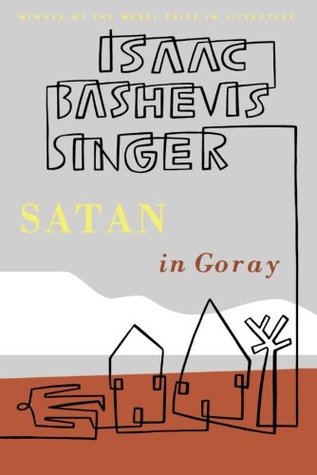
Book Review: Satan in Goray by Isaac Bashevis Singer
 2016 review of a book written
by an author whose family name starts with the letter
A B C D E F G H I J K L M N O P Q R S T U V W X Y Z
Today the world of the traditional Jewish shtetl in Eastern Europe only lives on in musicals like Fiddler on the Roof, films like Yentl and books like Satan in Goray. The opponents of World War II wiped it out ravaging homes and slaughtering people. Some like Isaac Bashevis Singer, the 1978 laureate of the Nobel Prize in literature, were lucky to get a chance to leave in time, but the great majority was either killed on the spot or transported to deadly concentration camps scattered all over Nazi Germany. However, the holocaust was only the broadest stroke against Jews in the region. There were other pogroms like the Khmelnytsky Massacres of 1648 that serve as starting point of the novel Satan in Goray by Isaac Bashevis Singer. Years later the survivors return to their small town and are only too willing to believe the rather unholy message of a Messiah doing miracles in the Promised Land.
Friday, 12 December 2014
Book Review: The Winter of Artifice by Anaïs Nin
 Originally, I intended to close my cycle of reviews for the Books on France 2014 reading challenge only in two weeks with the novel Voyage d’hiver by Amélie Nothomb, but unfortunately it seems that this work of the Belgian author – unlike most others – hasn’t been translated into English yet. As a result, I had to change my plans and look for another France-related book with the word WINTER in the title (»»» see my post on the current special). In the end I picked a collection of three novellas of which two are set in France: The Winter of Artifice by Anaïs Nin, namely the original published in Paris in 1939 which is available as a facsimile edition. The author wrote her diary-style stories revolving around love and passion in English although her mother tongue was French.
Friday, 29 August 2014
Book Review: A Palace in the Old Village by Tahar Ben Jelloun
 For the Books on France 2014 reading challenge I continue to revel in the wealth of Francophone literature for a little longer, but from the long past Middle Ages I’m returning to the present. Moreover, the book that I’m reviewing today has a strongly Maghrebian touch which it owes both to the author from Morocco and to its expatriate protagonist. A Palace in the Old Village by Tahar Ben Jelloun is a short novel about one of many foreign workers from Northern Africa who came to France in the 1960s to have a better life and who, probably out of fear to lose their identity, cherish and cultivate the cultural heritage of their places of origin, notably their Muslim creed, with more fervour than they might if they had stayed in their home countries.
Tahar Ben Jelloun (الطاهر بن جلون) was born in Fes, French Morocco, in December 1944. After graduation he studied philosophy in Rabat and worked as a philosophy teacher until 1971, the year when he published his first volume of poems. Following the arabisation of education in his country, he moved to France where he wrote articles for Le Monde, studied Social Psychiatry and later worked as psychotherapist. At the same time he kept publishing poems and fiction, but fame only came in 1985 with the release of The Sand Child (L’Enfant de Sable). The most important novels of the prolific francophone author are The Sacred Night (La Nuit Sacrée: 1987), The Blinding Absence of Light (Cette aveuglante absence de lumière: 2001), and A Palace in the Old Village (Au pays: 2009). His latest published novel is L’ablation (2014; Ablation). Tahar Ben Jelloun lives in Tangier, Morocco, with his family.
The story of A Palace in the Old Village revolves around Mohammed Ben Abdallah who was born and raised in a poor village in Southern Morocco where he was taught to recite the suras of the Koran and where he also married his sixteen-year-old cousin. As a young man he went to France to join the masses of foreign workers who were recruited by a thriving automobile industry during the years of the post-war economic miracle in Europe. He meant to earn money abroad for a while and then return home, but in the end he fetched his wife and stayed for forty years, thus his entire working life. During all those years Mohammed clang to his inherited culture and didn’t allow anything French to touch his soul. He warded off the “Lafrance”-infection as he called it and even refused to speak French although he understood it at least. He remained a Muslim, a father and a Moroccan through and through. At the same time he was humble and peaceful disapproving of all kinds of fanaticism, violence and racism. He tried to pass on his values, his traditions and his language to his five children, but they were born in France, attended French schools and refused their Arabic heritage in favour of a “normal” life as French citizens. They only spoke French, chose the professions they wanted, lived where they wanted, married whom they wanted, and Rachid even changed his name into Richard to mask his origins. They don’t obey him, but he is proud of them despite all. Only his youngest daughter Rekya who hasn’t yet finished school and Nabile, his mentally handicapped nephew and foster-son, are still living with Mohammed and his wife, when his turn comes to retire from his job. All of a sudden he realizes that the big flat in Yvelines has turned empty and that he lost his family to the foreign land. He dreads that he may die alone in a country that isn’t his own and that nobody will take care of his grave in Lalla França. So he sets out for his old village in Morocco to build the big house of his dreams that will bring back together his family and restore the traditional order.
All in all there doesn’t happen much in A Palace in the Old Village because it’s just the quiet story of an average man without exceptional qualities, nor great ambitions, nor an adventurous spirit. He’s an illiterate immigrant like many others in his generation, an everyman devoted to hard work and raising his children who in the end resorts to the impossible dream of making his family return to Morocco with him although for all except his wife the country is just a place where they spent their school summer holidays. The tone of the novel is melancholic or resigned as would be the account of a real person looking back on forty years away from home and finding himself estranged from his children because his soul never truly took root in France. In several flashbacks the third-person narrator tells memorable episodes from Mohammed’s past as well as his reflections on questions of religion, society and family. Extremism, racism and violence are beyond him whose idea of the world is based upon a strong belief in the mercy of Allah, a soft heart and a humble mind. Tahar Ben Jelloun portrayed Mohammed with great care and skill moulding an entirely credible character who feels made of flesh and blood from beginning to end. He succeeded in showing the isolation that results from the refusal or incapability of adapting to a different cultural environment in a very clear and unpretentious language full of powerful images. The German translation titled Zurückkehren was a pleasure to read and I hope that the English one is just as convincing.
For me A Palace in the Old Village by Tahar Ben Jelloun was a very touching read which allowed me a first-hand insight into the background and the mind of a Muslim immigrant who refuses all change of attitude and thus remains a stranger for decades. It helps to understand a little better why the communities of foreign workers tend to create parallel universes of their own within the “native” society. For this reason and for its literary quality I warmly recommend the novel.
Friday, 15 August 2014
Book Review: The Radetzky March by Joseph Roth
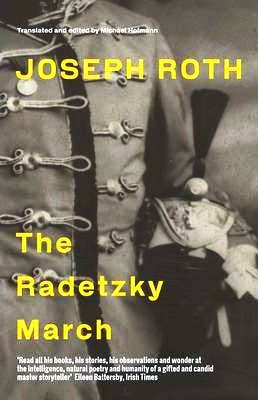 A hundred years after the outbreak of the Great War we often wonder how the light and merry belle époque could lead the world into a barbaric carnage of unprecedented dimensions. Taking into account that propaganda was running wild at the time, it is difficult to say if people, above all military and bourgeoisie, really welcomed the war with as much patriotic fervour as is reported, but it seems that the atmosphere in the early twentieth century was very peculiar. In the realm of fiction one of the most succeeded and important depictions of life in the Austro-Hungarian Dual Monarchy during the decades before its fall is The Radetzky March by Joseph Roth which I’m reviewing today. It’s the chronicle of three Barons Trotta von Sipolje, descendants of poor Slovenian farmers, whose lives are determined by their instilled devotion to Emperor Francis Joseph I and to Austria-Hungary.
Joseph Roth, full name Moses Joseph Roth, was born in Lemberg (today: Lwow), Galicia, Austria-Hungary (today: Ukraine) in September 1894. Until the outbreak of World War I he studied philosophy, German philology and literature at the universities of Lemberg and Vienna. In 1915 his first novella Der Vorzugsschüler (The Honours Student), was published. While working in the news service of the Austro-Hungarian army from 1916 on, he began his career as a journalist and continued writing fiction. The most important literary works of the prolific writer are The Spider’s Web (Das Spinnennetz: 1923), Job: The Story of a Simple Man (Hiob. Roman eines einfachen Mannes: 1930) and above all The Radetzky March (Radetzkymarsch: 1932) as well as its sequel The Emperor’s Tomb (Kapuzinergruft: 1938). Following complications caused by chronic abuse of alcohol, which he dealt with in his novella The Legend of the Holy Drinker (Die Legende vom Heiligen Trinker: 1939), Joseph Roth died in Paris, France, in May 1939.
The main scene of The Radetzky March is Austria-Hungary in the early twentieth century through the first years of World War I although the chronicle actually begins in the Battle of Solferino in 1859. Inexperienced as the young Emperor Francis Joseph I is in war matters (he is not yet thirty), he lifts his field glasses before the enemy has fully withdrawn. Infantry Lieutenant Joseph Trotta knows the danger from snipers and dives at the Emperor to save him. His rewards are promotion to the rank of Captain, ennoblement to Baron Trotta von Sipolje… and a bullet in his collarbone. Inevitably life changes for the hero of Solferino who finds himself sort of uprooted because he no longer belongs to the class of ordinary soldiers and citizens, nor feels comfortable among aristocrats. Eventually, he marries and has a son, Franz, whom he sends to cadet school in Vienna as becomes his station. When he finds out that his act of heroism in the battle of Soferino is exaggerated in his son’s school books, he asks that facts are set right. After his audience with the Emperor he retires to his wife’s country estate where he takes to managing the farm and requires his son to promise him to never join the army. As is a good son’s duty, he obeys and successfully pursues a career as a lawyer in the civil service. Two years after the death of his father, Franz Baron Trotta of Sipolje is appointed District Administrator in W., a small town in Moravia. He marries and has a son, Carl Joseph, whom he sends away to cadet school in Vienna. Carl Joseph grows up in an atmosphere of strict routines both in school and at home. At the age of eighteen, he joins the cavalry as his father wishes because for the grandson of the hero of Solferino a military career is the only suitable choice. Carl Joseph feels out of place and he is bored like all his comrades, but he is quickly dragged into the typical life of a soldier in peacetime which involves streams of alcohol, gambling, duelling with pistols, visits to the brothel and passionate love. Serious trouble is predestined and behind the horizon war is looming.
Life in The Radetzky March passes under the eyes of two great father figures who look down on all three Trottas from their canvases and determine their lives. One is the hero of Solferino who would much rather have remained an anonymous soldier in his Emperor’s army and the other is Emperor Francis Joseph I himself who rules multiethnic Austria-Hungary during sixty-eight years. Both idols are fixed stars in the universe of the Trotta family around which each generation revolves. Also the melody of the Radetzky March, which Johann Strauss Sr. composed in honour of the heroic Austrian Field Marshall Joseph Count Radetzky von Radetz (1766–1858) in 1848, thus the year of Francis Joseph’s accession to the throne, is a red thread running through the entire novel and like life in the Austro-Hungarian Dual Monarchy it always goes on unchanged in the way of a haunting tune. The author’s focus is on Carl Joseph Baron Trotta von Sipolje whose story not just shows his tragic fate, but at the same time reflects in great detail social and military life in the early twentieth century. As always, the language in which Joseph Roth told his novel is a mere delight to read – it’s elegant, precise, poetic and powerful from beginning to end. If the English translation is only half so good, it’s still excellent.
The Radetzky March by Joseph Roth is one of my all-time favourite novels and I’m glad that an English translation is available. To my great satisfaction I found out recently that the late German literary critic Marcel Reich-Ranitzky included it into his canon of the most important literary novels in German language, and quite on top of the list. I shouldn’t be surprised. Not without reason scores of German teachers have read it with their students since it first appeared in 1932. It certainly deserves the popularity and I join them with my recommendation.
Wednesday, 19 February 2014
Veza Canetti
 There can be no doubt that the name Canetti is well-famed in the world of literature. Elias Canetti it goes without saying since it was he who was awarded the Nobel Prize in Literature in 1981. However, there’s also an Austrian writer carrying the family name: Veza Canetti, the first wife of the famous Nobel Prize laureate. Of course, she is present in some of his essays as well as in his autobiographies and after her death he dedicated all his publications to her, but the literary picture that the acclaimed author painted of her is strongly tinged by female ideals of the 1920s and 1930s. Veza Canetti appears as “literary muse”, “oriental princess”, “jealous partner”, “melancholic raven”, and “sacrificing woman without own ambitions”. That she happened to be a talented writer doesn’t seem to have mattered to the great man of letters.
Veza Canetti was born as Venetiana Taubner-Calderón in Vienna, then Austria-Hungary, on 21 November 1897. Her father was an Ashkenazi-Jewish merchant from Hungary who died when she was six years old. Her mother, a descendent of Spanish-Sephardic Jews who had settled down on the Balkans, more precisely in Belgrade, Serbia, soon remarried to be provided for with her daughter. Little is known about Veza’s childhood and youth, but despite a physical defect – she had no left forearm so her hand was joined directly to the elbow – those forming years seem to have been quite ordinary. The girl graduated from a grammar school in Vienna and often visited her numerous relatives on the British Isles to improve her English. Besides, she applied herself to studying French, Spanish and Italian on her own.
After the end of the Great War In 1918 Veza Taubner-Calderón worked as an English teacher at a private grammar school in Vienna until it was closed four years later. After that the young woman made her living as a translator into German and giving private English lessons. She also attended lectures of Karl Kraus (one of the grand men of Austrian literature at the time known today above all for his play The Last Days of Mankind from 1918) at the university of Vienna where she met her husband-to-be, Elias Canetti, in 1924. In the early 1930s Elias Canetti began working on his first (and only fiction) novel Auto-da-fé and also Veza turned her attention to writing. With the help of one of her students, she made her literary debut with a short story in the Wiener Arbeiter-Zeitung, a newspaper of the social-democratic party in Vienna, in 1932.
During the following two years Veza Taubner-Calderón continued to publish in different newspapers and anthologies. Being Jewish, however, she could not use her real name, but had to resort to different pseudonyms like Veza Magd, Veronika Knecht, Martha/Martina/Marina/Martin Murner. Her rather radical short stories drawn from everyday life touched on burning issues like poverty, unemployment, abuse of power, humiliation, and violence within the family which wasn’t welcome after the events of February 1934 (Austrian Civil War and takeover of power by Austrofascists with conservative Catholic-patriotic ideals as answer to rising National-Socialism under Hitler in Germany). Veza’s novel titled Die gelbe Straße could not be released as planned anymore and the Jewish socialist writer had little opportunity to further publish her work.
In 1934 Veza Taubner-Calderón married Elias Canetti and adopted his family name as required Austrian law. It is known that Veza wrote two not yet found novels, Kaspar Hauser and Die Genießer, until November 1938 when the Canettis fled via Paris, France, to London, U.K., where they settled down in 1939. In exile Veza Canetti produced Die Schildkröten, but couldn’t find a publisher for the novel. Since earning a living became a pressing issue, Veza put aside her own ambitions and worked as a translator from English again. For the rest she contented herself with supporting her husband’s work as his muse, literary assistant and sometimes secretary although he had several intense affairs. As it seems, Veza Canetti lost all hope for a breakthrough as a writer by 1956 and rumour has it that she not only gave up writing altogether, but also destroyed many of her manuscripts.
Veza Canetti died in London, U.K., on 1 May 1963. The little that remains of her literary heritage has been (re)discovered and (re)published only in the 1990s and in the new millennium. Available in English are her novels Yellow Street: A Novel in Five Scenes (Die gelbe Straße: 1990) and The Tortoises (Die Schildkröten: 1998), plus the collection Viennese Short Stories (including among others the early stories from the German-language collection Geduld bringt Rosen: 1995). In German also the play Der Oger (1991) and more short stories Der Fund (2001) have been brought out.
For further reading I recommend the following biography:
Julian E. Preece (2007) The Rediscovered Writings of Veza Canetti: Out of the Shadows of a Husband. Studies in German Literature Linguistics and Culture. Camden House, Rochester USA ISBN 9781571133533
Julian E. Preece (2007) The Rediscovered Writings of Veza Canetti: Out of the Shadows of a Husband. Studies in German Literature Linguistics and Culture. Camden House, Rochester USA ISBN 9781571133533
Friday, 13 December 2013
Book Review: The Christmas Carp by Vicki Baum

The number of Austrian writers from the first half of the twentieth century whose works have been translated into English is small. Few of them are still remembered today and even less of them wrote Christmas stories. The latter fact actually isn’t really a surprise since many of them were Jewish. Despite all I managed to dig out a Christmas story by a rather famous Austrian writer of the interwar period who resided in Germany after 1914 and in the USA as from the early 1930s. The Christmas Carp by Vicki Baum is a product of World War II and it is one of her early fiction written in English instead of her native German. I decided to review it although the original English edition has been out of print already for ages.
Hedwig “Vicki” Baum was born into a well-to-do Jewish family in Vienna, Austria-Hungary, in January 1888. Already at an early age she began writing and after her mother’s death from cancer she published her first novel Frühe Schatten in 1914. Despite all she first opted for a musical career and became a harpist of repute in Germany. Her second novel Once in Vienna (Der Eingang zur Bühne) came out in 1920 and started off her career as a full-time writer. During the 1920s she became one of the most popular authors of mainstream melodramatic novels in the German-speaking world. It was only in 1929 that the prolific writer had her international break-through with Grand Hotel (Menschen im Hotel). After a promotion tour around the USA she settled down in California with her family in 1932 and continued to write first in German and from 1941 on in English. The most notable among her later works are Love and Death in Bali (Liebe und Tod auf Bali: 1937; also translated as A Tale of Bali), Shanghai ’37 (Hotel Shanghai: 1939; also translated as Nanking Road), The Christmas Carp. A Story (1941), Berlin Hotel (1943), Weeping Wood (1943), and The Mustard Seed (1953). Vicki Baum died in Hollywood, California, USA, in August 1960. Her autobiography It Was All Quite Different (Es war alles ganz anders: 1962; also translated as I Know What I’m Worth) was published posthumously.
The scene of The Christmas Carp is the home of the Lanner family in the Austrian capital Vienna. The story begins on a Nikolaus Day, that is to say on a 6 December in the 1920s, when Friedel and the twins Annie and Hans are still small enough to believe in all the magic stories connected to the season which they are being told by adults. But Nikolaus Day marks the true beginning of Christmastime for the whole family because the visit from Saint Nikolaus and his diabolic companion Knecht Ruprecht unfailingly coincides with the arrival of the widowed aunt Mali from the country who joins the Lanners to help with Christmas preparations and to celebrate with the family. Every year they have the idyllic Christmas of a well-to-do Catholic household with a beautifully decorated Christmas tree, a table laden with presents, heaps of savoury Christmas biscuits and for dinner a carefully chosen Christmas carp from the Jewish fishmonger whose carps are the best and most beautiful in all Vienna. But time doesn’t stand still. The children grow up, Austria is annexed to Hitler’s Third Reich and at last the country is at war. Friedel is a pilot, Annie is engaged to Paul, a lieutenant stationed in France, and Hans works in an ammunition factory instead of continuing his pharmacy studies. With the war comes penury, but old aunt Mali still travels from her relatively safe country home to Vienna and is determined to prepare a wonderful Christmas dinner for the family. After all, she has the Lanners’ cookery-book in which she put down her recipes for unheard of delicacies made of the most unlikely ingredients during the years of World War I. She even managed to trace out the Jewish fishmonger to have a carp for Christmas dinner as usual, but there’s a hitch to it. It’s only 6 December and she had to take the fish to Vienna alive. The only solution is to put the ugly little carp into the bath tub and to care for it until Christmas.
In my German edition The Christmas Carp is a short story of scant fifteen pages, so it may be even shorter in English. Vicki Baum made it her task to make a non-Austrian audience, especially American readers, acquainted with typically Austrian Christmas traditions. However, they are only the peaceful and merry background for a plot showing the consequences of a cruel and destructive war on the level of a family and their impact on everyday life including dear habits. The carp serves as a symbol for the millions of innocent victims of the war as reveals the final passage. Vicki Baum’s style and language are simple, clear and rather matter-of-fact although – especially in the second half – the author also doesn’t spare with irony. The story is serious and thoughtful as well as funny and entertaining. For me the beginning was a bit slow because it contains several explanations regarding Austrian traditions which I know rather well of course. A non-Austrian reader may feel differently about it. The characters of the story, above all aunt Mali who is expressly described as quite an original, are well depicted and feel like real people.
I enjoyed reading The Christmas Carp by Vicki Baum. It’s a pity that the short story is out of print (like almost all this Austrian author's works) and only few will get a chance to read it. It’s not just a story about a family Christmas, but it’s also a testimony of a time when war raged in Europe and people had to improvise to make possible a decent Christmas dinner in the middle of senseless slaughtering and destruction.
Friday, 13 September 2013
Book Review: The Courilof Affair by Irène Némirovsky
 Russia is a huge country with a rich history. Lamentably, it has also been a history of recurring violence. Already before the Russian revolution of 1917 Communist and other activists used terrorism as a means to force political change and the tsarist government answered all those attempts with rigorous actions tightening its grip on the population. Outside Russia little is known today of those forerunners of the revolution and the victims on either side. I think that The Courilof Affair by Irène Némirovsky is an excellent novel to shed a little bit of light on this forgotten period of history.
Irène Némirovsky was born in February 1903 in Kiev, then Russia, now Ukraine. When she was fourteen, she and her wealthy family fled from the terrors of the October Revolution raging in the tsarist capital St. Petersburg and settled down in France two years later. Irène Némirovsky studied literature at Sorbonne University, while already working on her career as a writer. After several short stories and novellas, the author’s first novel, The Misunderstanding (Le Malentendu), was published in 1926. The best-selling novels David Golder and Le Bal followed in 1929 and 1930 respectively. Until Nazi-Germany invaded France in 1940 the prolific writer, who was refused naturalization due to her Jewish origins, brought out a new novel almost every year, one of them The Courilof Affair (L’affaire Courilof) in 1933. Irène Némirovsky continued writing until she was arrested by French police and deported to Auschwitz where she died from typhus in August 1942. Several of her works have been published posthumously, among them the biography A Life of Chekhov (La vie de Tchekhov: 1946) and her most famous, yet unfinished work Suite française (2004).
The Courilof Affair is a fictitious novel based on real events of Russian history. In 1931 the first-person narrator León M., who lives in Nice, France, and faces death from pulmonary tuberculosis, feels the urge to write down the true account of a fatal bomb attack in St. Petersburg in which he was involved in 1903. He is the son of Russian revolutionaries deported to Siberia, but grew up in exile in Geneva, Switzerland, where he was raised to be a revolutionary and an assassin. In January 1903 León M. is twenty-two and the revolutionary committee to which his mother belonged until her death more than ten years earlier charges him with the liquidation of Valerian Alexandrovitch Courilof, the much despised Minister of Education under the last Russian Tsar Nikolai II. He travels to Kiev to meet Fanny who is his liaison with the local revolutionaries and full of hatred against the ruling classes. At Easter they move on to St. Petersburg together where he is supposed to spy out Courilof and to wait for further instructions. He lives under the name of Marcel Legrand, a doctor of medicine from Geneva, and goes into service with Courilof for the summer. Soon León M. learns that the minister is not only a feared, but also a hopelessly ill man who is the target of political intrigues at court. The more he knows about the real Courilof the more he perceives him as a human being, moreover as just another poor fool like everybody else and one whom he likes in a way. By the time when the date for the assassination is finally fixed, he’s in inner conflict about his task, but there are still a few months left to sort things out.
To write the invented autobiography of a political assassin in tsarist Russia without demonizing or canonizing anybody along the way is a challenge which Irène Némirovsky mastered brilliantly in The Courilof Affair. The first-person narrator isn’t emotional about the events which he unfolds. On the contrary, he – thus the author as his mastermind in the background – tells the whole story in the matter-of-fact language of someone who has long done with the past. The depicted characters are human beings with strengths and weaknesses like people in the real world around us. They have hopes and fears, they have desires and aversions, they have a conscience and they have a past which moulded them. Each one of them acts according to his or her nature and knowledge. The atmosphere of tsarist St. Petersburg just after 1900 feels very authentic and the plot which is modelled after history seems very realistic.
All things considered, The Courilof Affair by Irène Némirovsky has been an interesting and rewarding read. It’s the author’s sixth novel and not her most famous one, but it’s the only one which I had the pleasure to read so far. I put her other works on my list of books to read although I have no idea when I’ll get to them. So many books, so little time! In any case, Irène Némirovsky deserves more room in my shelves. She was a great author. How many more wonderful novels could she have finished, hadn’t she been deported to Auschwitz by the blind followers of fanatics and hadn't she died a senseless death in the concentration camp like too many others.
To write the invented autobiography of a political assassin in tsarist Russia without demonizing or canonizing anybody along the way is a challenge which Irène Némirovsky mastered brilliantly in The Courilof Affair. The first-person narrator isn’t emotional about the events which he unfolds. On the contrary, he – thus the author as his mastermind in the background – tells the whole story in the matter-of-fact language of someone who has long done with the past. The depicted characters are human beings with strengths and weaknesses like people in the real world around us. They have hopes and fears, they have desires and aversions, they have a conscience and they have a past which moulded them. Each one of them acts according to his or her nature and knowledge. The atmosphere of tsarist St. Petersburg just after 1900 feels very authentic and the plot which is modelled after history seems very realistic.
All things considered, The Courilof Affair by Irène Némirovsky has been an interesting and rewarding read. It’s the author’s sixth novel and not her most famous one, but it’s the only one which I had the pleasure to read so far. I put her other works on my list of books to read although I have no idea when I’ll get to them. So many books, so little time! In any case, Irène Némirovsky deserves more room in my shelves. She was a great author. How many more wonderful novels could she have finished, hadn’t she been deported to Auschwitz by the blind followers of fanatics and hadn't she died a senseless death in the concentration camp like too many others.
Tuesday, 28 May 2013
Exiled Writers Ink: Voices in a Strange Land
The United Nations’ Universal Declaration of Human Rights from 1948 postulates in its Article 19 the freedom of opinion and expression. In my corner of the world, in the European Union, this fundamental right has become a matter of course and writers usually don’t give it much thought, but in many – far too many – countries authors face censorship and repression every day. There literary or journalistic work can put at risk the freedom and even the life of the writers themselves as well as of their families. Is it a surprise that under such conditions critical minds decide to go into exile?
For writers the decision to leave their countries of origin is even more difficult than for others because in their work they depend almost always on the use of their native language. Going into exile can thus deprive them of access to the literary community and to publishing. Since few authors can be expected to be as gifted for foreign languages as for instance Joseph Conrad (who was a Pole writing in English), the registered charity Exiled Writers Ink was formed in London. Its mission is to provide a platform ‘for the work of artists living in exile in the UK and mainland Europe’.
On its website Exiled Writers Ink states that in order to fulfil its mission, it regularly organises creative writing workshops for refugees as well as for other exiles and it offers workshops with (established) exiled writers in schools, colleges and groups. It also arranges seminars and conferences, theatre performances, festivals and other events in the UK, often in collaboration with other organizations. Another important contribution of Exiled Writers Ink to the literary scene is Live Literature, for example the Exiled Lit Café taking place every first Monday of the month in London.
The work of Exiled Writers Ink would be only half-hearted, if it didn’t include matters of publication and translation as well. One of the charity’s projects is dedicated to matching exiles and English writers for the purpose of working together on the English editing. In return the exiled or refugee authors translate work of the partner into their own languages. As the website says, volunteers for helping with the editing are always welcome. The results of such collaboration in a literary tandem are published and presented in a performance arranged by Exiled Writers Ink.
The online list of publications by writers associated with Exiled Writers Ink is long, but the charity can come up with own publications, too. Several anthologies of exiled literature have been edited by its director, Jennifer Langer, and some booklets are available along with the books produced in the Mentoring and Translation Programme. Until winter 2010/11 a magazine called exiled ink! has been published and its issues 4 to 14 can be downloaded from the website for free. Lamentably it seems that the magazine no longer appears, not even on the internet.
The website of Exiled Writers Ink gives a good overview of the charity’s activities. It’s an initiative that can’t be overrated because it shows how much power of expression and wealth of thought refugees and exiles bring to our countries. All we need to do is give them a chance to follow their literary ambitions - in other words: to write without fear.
Subscribe to:
Posts (Atom)