Friday, 29 April 2016

Book Review: Tierra del Fuego by Sylvia Iparraguirre

http://d.gr-assets.com/books/1180854189l/1084710.jpg2016 review of a book written
by an author whose family name starts with the letter
A B C D E F G H I J K L M N O P Q R S T U V W X Y Z

It’s a sad fact that for centuries most Europeans looked down on indigenous peoples living in the countries that their explorers not only discovered but also conquered. How often do we find that they were treated like wild beast and some of them brought to Europe to entertain kings and queens or to show in curiosity shops. Missionaries and colonists were hardly any more understanding and open-minded towards seemingly primitive cultures. In the epistolary novel Tierra del Fuego by Sylvia Iparraguirre a fictional Anglo-Argentine seaman recounts true events from the early nineteenth century surrounding a native Patagonian who is known as Jemmy Button. As a young man he was brought from Tierra del Fuego to London to learn the basics of English civilisation and years later he was put on trial, then sentenced and executed for having played a leading role in the massacre of English missionaries in the islands.

Wednesday, 27 April 2016

Reads for Walpurgis Night

Francisco de Goya y Lucientes - Witches' Sabbath (The Great He-Goat)
Francisco de Goya (1746-1828), via Wikimedia Commons
Witches' Sabbath or The Great He-Goat, (1821-1823)  from the Black Paintings Series
oil on canvas,
140.5 x 435.7 cm
Prado Museum, Madrid

The night of 30 April is Walpurgis Night, the night of the witches. According to Germanic folklore it’s the night when witches and sorcerers meet on the Brocken, the highest peak of the Harz Mountains in central Germany, to celebrate one of the infamous Witches’ Sabbaths. Many legends of witches who worship Satan banqueting, dancing, cavorting, and having sex shroud the night… and unfortunately, fuelled the imagination of men like Heinrich Kramer, the author of the Malleus Maleficarum or Hammer of Witches. Thus it is inseparably linked to one of the darkest periods in European history, namely that of witch-hunts and auto-da-fés.

It goes without saying that the feast also found expression in literature, not to mention that as late witches have come quite into fashion among writers. Here’s an arbitrary selection of ten suitable reads for Walpurgis Night:
  1. John Bellairs: The House with a Clock in Its Walls (1973)
  2. Mikhail Bulgakov: Мaстер и Маргарита (1967), translated as The Master and Margarita 
  3. Paulo Coelho: A Bruxa de Portobello (2006), translated as The Witch of Portobello 
  4. Karl Kraus: Die Dritte Walpurgisnacht (1933), no translation found
  5. H. P. Lovecraft: The Dreams In the Witch House (1932) 
  6. Thomas Mann: Der Zauberberg (1924), translated as The Magic Mountain
  7. Gustav Meyrink: Walpurgisnacht (1917) 
  8. Thomas Pynchon: Gravity's Rainbow (1973) 
  9. Bram Stocker: Dracula’s Guest (1914) 
  10. Dennis Wheatley: The Devil Rides Out (1934)

Monday, 25 April 2016

Poetry Revisited: A Fancy by Helen Leah Reed

A Fancy

(from Memorial Day and Other Verse: 1917)

The world of dreams is all my own,
Wherein I wander – free, alone; –
And each weird, fervid fantasy
Is dearer than earth’s joys to me.
The waking world I share with you;
And yours, as mine, is the ocean's blue.
For us both spring’s early flowers are fair,
Or the cold stars gleam through the frosty air.

But in the world of dreams I rove
Over sunny fields, or in shaded grove, –
Such beauty your eyes never saw –
And all is mine without let or law.
Ah! the hopes and fears that come and go
With my flying fancy, none may know;
Though unsubstantial, it seems
My real world – this world of dreams.

Helen Leah Reed (1860-1926)
American teacher and author of children’s books

Friday, 22 April 2016

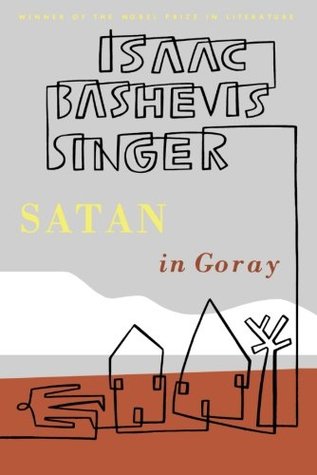
Book Review: Satan in Goray by Isaac Bashevis Singer

http://www.goodreads.com/book/show/27049.Satan_in_Goray2016 review of a book written
by an author whose family name starts with the letter
A B C D E F G H I J K L M N O P Q R S T U V W X Y Z

Today the world of the traditional Jewish shtetl in Eastern Europe only lives on in musicals like Fiddler on the Roof, films like Yentl and books like Satan in Goray. The opponents of World War II wiped it out ravaging homes and slaughtering people. Some like Isaac Bashevis Singer, the 1978 laureate of the Nobel Prize in literature, were lucky to get a chance to leave in time, but the great majority was either killed on the spot or transported to deadly concentration camps scattered all over Nazi Germany. However, the holocaust was only the broadest stroke against Jews in the region. There were other pogroms like the Khmelnytsky Massacres of 1648 that serve as starting point of the novel Satan in Goray by Isaac Bashevis Singer. Years later the survivors return to their small town and are only too willing to believe the rather unholy message of a Messiah doing miracles in the Promised Land.

Wednesday, 20 April 2016

Back Reviews Reel: April 2013

In April 2013 I reviewed four books that I chose according to the theme of the respective week. With the exception of the contemporary novel The Shadow of the Wind by Carlos Ruiz Zafón that ended the posts exploring guilt and atonement, all reviewed books were famous classics, two of them written by Nobel laureates and one of them in the public domain. The first book on my schedule, however, was The Plague by Albert Camus (recipient of the Nobel Prize in Literature of 1957) because the week was dedicated to the African continent. Then I turned to the era that brought forth what is commonly known as decadent movement today and reviewed the public domain novel The House of Mirth by Edith Wharton, the only female writer featured that month. On the following Friday I discussed the novella Siddhartha by Hermann Hesse (1946 winner of the Nobel Prize in Literature) dealing – among others – with vocation as theme of the week. 

Monday, 18 April 2016

Poetry Revisited: April Dawn by Isaac Rosenberg

April Dawn

(from Youth: 1915)

Pale light hid in light
Stirs the still day-spring;
Wavers the dull sight
With a spirit's wing.

Dreams, in frail rose mist,
Lurking to waylay,
Sublte-wise have kist
Winter into May.

Nothing to the sight...
Pool of pulseless air.
Spirits are in flight,
And my soul their lair.

Isaac Rosenberg (1890-1918)
English poet and artist

Friday, 15 April 2016

Book Review: South Riding by Winifred Holtby

http://www.goodreads.com/book/show/9932965-south-riding2016 review of a book written
by an author whose family name starts with the letter
A B C D E F G H I J K L M N O P Q R S T U V W X Y Z

Nobel Prize laureate in Literature Sir Winston Churchill once quoted an unknown source stating “that democracy is the worst form of government except all the others that have been tried.” Witnessing the poor performance of politicians in virtually all important matters of modern life, this can be hard to believe. In fact, many of us feel that politics have ceased to be about people because our representatives seem to care only about money and power instead of getting anything done. But this isn’t a new phenomenon as prove works of literature from all ages. The novel South Riding by Winifred Holtby shows how politics work on the local level, namely in the county council of the Yorkshire community from the title during the depression years of the 1930s, and how it affects the daily lives of people, notably of those who depend on the government to get along.