 It is often said that centuries-old literature is too remote from modern life to have any regard to current affairs. In fact, real classics are universal and timeless which allows every new generation to gain new insights from them. Moreover it’s a big mistake to believe that they are inconspicuous from a political point of view. As one of my teachers at university used to say, everything is politics – not one of us can live without making political statements all the time, be it through the choice of a read. The literature-loving protagonist of Pereira Maintains by Antonio Tabucchi learns it the hard way. The literary editor of a newspaper in fascist Portugal doesn’t expect that publishing the translations of French nineteenth-century classics will get him into trouble with the terror regime of António de Oliveira Salazar just like his young trainee Francesco Monteiro Rossi and his friend Marta who are active in the resistance.
Showing posts with label Lisbon. Show all posts
Showing posts with label Lisbon. Show all posts
Friday, 8 May 2015
Book Review: Pereira Maintains by Antonio Tabucchi
It is often said that centuries-old literature is too remote from modern life to have any regard to current affairs. In fact, real classics are universal and timeless which allows every new generation to gain new insights from them. Moreover it’s a big mistake to believe that they are inconspicuous from a political point of view. As one of my teachers at university used to say, everything is politics – not one of us can live without making political statements all the time, be it through the choice of a read. The literature-loving protagonist of Pereira Maintains by Antonio Tabucchi learns it the hard way. The literary editor of a newspaper in fascist Portugal doesn’t expect that publishing the translations of French nineteenth-century classics will get him into trouble with the terror regime of António de Oliveira Salazar just like his young trainee Francesco Monteiro Rossi and his friend Marta who are active in the resistance.Friday, 10 April 2015
Book Review: The Return of the Caravels by António Lobo Antunes
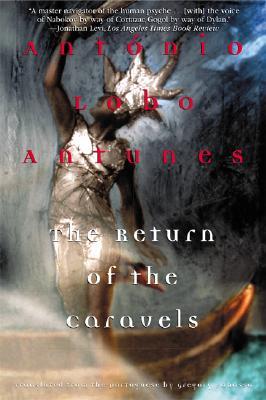 This week I was in the mood for Portuguese literature and decided to review a book by António Lobo Antunes. My first choice was Tratado das Paixões da Alma (Treatise on the Passions of the Soul), but as so often I was annoyed to find that it hasn’t been translated into English. Easter just past (or ahead in the Orthodox Christian Churches) it would have felt odd to talk about a book half set on Christmas Eve, so I ruled out The Splendor of Portugal. At last I turned towards The Return of the Caravels by António Lobo Antunes which offers a delirious fusion of Portugal’s rise to and fall as a colonial power between the sixteenth century and 1974. The seedy old colonists who return to Lisbon after many decades away are at the same time the former discoverers and great names of Portuguese history.
Friday, 4 July 2014
Book Review: The Following Story by Cees Nooteboom
 After going a little astray for a full month, I felt like returning to the old rut again and in the end picked a rather slim volume from my shelves where it had been waiting undisturbed and patiently for many months. My penchant was towards something by a European author whose work has so far escaped my bibliomania and I was pleased to find that my instinct led me to a most intriguing philosophical novelette partly set in Lisbon. The Following Story by Cees Nooteboom deals with the many questions surrounding the experience of death and the inexplicable bond between body and mind, but also with matters of love and identity.
Friday, 14 February 2014
Book Review: The History of the Siege of Lisbon by José Saramago
 Is the past an objective reality that always stays the same? Is it a subjective and momentary, yet commonly accepted view of what once was? What if we did the unthinkable and changed the course of history with one simple stroke of the pen? Inserting one word into the proofs of a book, the protagonist of The History of the Siege of Lisbon by José Saramago does just that. He changes events that took place eight centuries earlier. And the arbitrary act of a proofreader serves the laureate of the Nobel Prize 1998 to combine a love story with metafiction about writing alternative history.
José Saramago, in full José de Sousa Saramago, was born in Santarém, Portugal, in November 1922. At first he worked as a car mechanic, but soon turned to translating and journalism which earned him a living until he lost his job as assistant editor of a newspaper in the mid-1970s. Only then José Saramago’s career as a full-time writer began. His first novel, Manual of Painting and Calligraphy (Manual de Pintura e Caligrafia), was published in 1977. General acclaim came with Baltasar and Blimunda (Memorial do Convento: 1982) and increased with novels like The Stone Raft (A Jangada de Pedra: 1986), The History of the Siege of Lisbon (História do Cerco de Lisboa: 1989), The Gospel According to Jesus Christ (O Evangelho Segundo Jesus Cristo: 1991), and Blindness (Ensaio sobre a Cegueira: 1995). In 1998 the Swedish Academy awarded the writer the Nobel Prize in Literature. Among his notable later works are The Double (O Homem Duplicado: 2002), Seeing (Ensaio sobre a Lucidez: 2004), Death at Intervals (As Intermitências da Morte: 2005), and his final novel Cain (Caim: 2009). José Saramago died on Lanzarote, Canary Islands, Spain, in June 2010.
Despite its title The History of the Siege of Lisbon doesn’t revolve around proven historical facts of the defeat of the Moors camping in front of the gates of Lisbon in 1147. Those important events of the Portuguese past serve José Saramago only as background for a story within the main plot taking place eight centuries later. Correcting the proofs of a history of the siege of Lisbon written by a renowned scholar, a poor proofreader in his early fifties called Raimundo Benvindo Silva feels the sudden and irresistible urge to insert a NOT where it doesn’t belong, a NOT that might have changed the course of Christian-European history, had the Crusaders on their way to the Holy Land really refused to help the defenders of the besieged city. When the mistake is discovered a few days later, an erratum sheet is added to the already printed copies and the publishing house engages Senhora Dona Maria Sara to supervise all proofreaders in order to avoid similar problems in future. The encounter of the bachelor Raimundo Silva and the divorcee Maria Sara is the beginning of their hesitant love story. Encouraged by Maria Sara the proofreader sets out to write his own, alternative history of the siege of Lisbon and is ever more drawn into his imaginative world crowded with twelfth-century Moors and Crusaders. At the same time he courts Maria Sara, at first with much restraint because he can’t imagine the younger woman to be interested in him, but like Morgueime and Ouroana in his historical novel they get closer day by day.
The History of the Siege of Lisbon is a partly metafictional novel told from the point of view of an omniscient narrator. The two plot lines, the historical novel that Raimundo Silva writes and the love story between Raimundo Silva and Maria Sara, are interlaced and often interdependent. In the story within the story the author plays with possibilities and probabilities that even most accurate historical research must leave open because it relies on usually very limited sources. In other words the message is that our picture of history can be no more than a collage of a smaller or greater number of snapshots of the past, moreover an arrangement of individual pieces showing the subjective touch of the person, people or society that put them together. And as uses to be the case with pictures, we can only guess what people thought – the perfect starting point for a novel! In fact, The History of the Siege of Lisbon gives an interesting insight into the creation of a historical novel set in an alternative past. The contemporary love story, on the other hand, shows the hopes and fears, the doubts and convictions of a man and a woman who are attracted to each other and yet afraid of being hurt (again) and how they take cautious steps towards each other. The novel is written in the typical style of José Saramago which can be quite a challenge at first because he refrains from using punctuation except many commas and scarce periods. Paragraphs are long and often incorporate complex dialogues which are made visible only by capital letters within the sentences. Despite all I had no problem at all following the plot.
For me The History of the Siege of Lisbon by José Saramago has been a very delightful and absorbing read, one of my best ever and one which made me long for more by this justly famous Portuguese author. Blindness confirmed my first impression and others of his novels made it on my list of books to read. In a nutshell, I enjoyed The History of the Siege of Lisbon immensely and am more than pleased to finally recommend this writer, particularly this book of his for reading.
* * * * *

This review is a contribution to the perpetual Read the Nobels challenge.
For more information and a complete list of books that I already reviewed for it »»» please read my sign-up post!
Friday, 8 November 2013
Book Review: The Night in Lisbon by Erich Maria Remarque

Erich Maria Remarque was born as Erich Paul Remark in Osnabrück, Germany, in June 1899. He studied to become a teacher when World War I broke out in 1914 and he was drafted into the army. After the war, in 1920, his first novel titled The Dream Room (Die Traumbude) was published. His most famous novel up to this day is All Quiet on the Western Front (Im Westen nichts Neues) which was first released as a book in 1929 and earned him a nomination for the Nobel Prize in Peace 1931. In 1933 Remarque’s books were banned and publicly burnt in Germany. Exiled first in Switzerland and as from 1939 in the USA he continued his career. In 1945 the best-selling novel Arch of Triumph (Arc de Triomphe) came out in English first. The Night in Lisbon (Die Nacht von Lissabon) appeared in 1962 and is the writer’s last finished novel. Erich Maria Remarque died in Locarno, Switzerland, in September 1970.
As the title suggests, The Night in Lisbon is set in the Portuguese capital, but its major part is taken up by a story within the story of a refugee with false identity who doesn't trust his memory and tells the first-person narrator about his and his late wife’s flight through Europe. The time period is before and during World War II when many citizens from areas under Nazi-German control or influence did everything in their power to escape from persecution and terror. The man who asks the narrator to stay with him during the night and to listen to his story in return for – saving – two ship tickets to the USA is a critical journalist from Osnabrück who after having been denounced by his Nazi brother-in-law Georg and detained in a concentration camp for a while fled to France in 1934. For five years he lived as an illegal alien, but then he inherited valid papers from another refugee known under the name Josef Schwartz. This gave him the (risky) opportunity to return to Germany and see his wife Helen. After only one night it was time for him to leave again because it was too dangerous in Osnabrück. Without even telling her husband, Helen decided to accompany him. They went to Switzerland first and moved on to Paris when Georg managed to trace them there. The beginning of the war in September 1939 put an end to their relatively happy existence. What followed were arrest, separation, detention camps and flight. With French police and Gestapo as a constant threat and Georg on their heels their odyssey brought them to Marseille. There Helen’s secret reasons to flee from the oppression of Nazi-ruled Germany as well as from her controlling brother Georg became so obvious that the husband could no longer ignore them. There Helen’s secret reasons to flee from the oppression of Nazi-ruled Germany as well as from her controlling brother Georg became so obvious that the husband could no longer ignore them. The following events which led to the murder of Georg drove the couple from Marseille and across the Spanish border in a hurry. Eventually they safely arrived in Lisbon, but for Helen the city of hope was the final destination.
The Night in Lisbon is a dense and easy-to-read novel which gives a gripping insight into the typical fate of refugees during World War II as the famous author himself experienced it to some extent. The whole novel is elaborate with a good flow and always to the point. Even the framing plot reflects the constant restlessness of people on the run, when the two men who made it to Lisbon are ever again driven away from a pub or bar at closing time and forced to find a new place to stay at for the rest of the night. The main story of the flight is a well-balanced series of dramatic events and their psychological effects on the protagonists, in brief the trying ups and downs of a life without a place or trustworthy people to resort to. All characters are nuanced and feel very authentic.
With thousands of people erring through the world in search of a safe place to settle down or just of a future worth living, Erich Maria Remarque’s The Night in Lisbon could hardly be more up-to-date. For us who we are living in countries which haven’t seen a war on their territories for many decades and which prosper despite all lamentations about the crisis, books like this are important to see how hard and shattering it is to be forced to leave your own country and not be welcome anywhere. It’s even worse if you need to fear for your life as the refugees of World War II. All things considered The Night in Lisbon is a very instructive and valuable read calling for humanity and understanding like all works of Erich Maria Remarque. I highly recommend this one.
Friday, 28 June 2013
Book Review: Night Train to Lisbon by Pascal Mercier
 Life is like a journey on a train. Sometimes it feels as if it were standing still although in reality we are advancing at the usual pace without noticing it because the landscape by the wayside is so uniform or dark. Sometimes we seem to be rushing through such an incredibly varying scenery that we get dizzy looking out of the window of our compartment. The big question is: do we prefer travelling through unspectacular and secure spheres or are we ready for some adventure and nausea? The novel Night Train to Lisbon by Pascal Mercier that I picked for today’s review deals with such choices and what makes us take them.
Pascal Mercier is the pen name of the Swiss writer and philosopher Peter Bieri who was born in Berne, Switzerland, in June 1944. After his studies of philosophy he pursued a scientific career becoming a full professor of philosophy at the Free University of Berlin in 1993. His debut novel Perlmann’s Silence (Perlmanns Schweigen) came out in 1995 and was followed by Der Klavierstimmer (The Piano Tuner, still untranslated into English) in 1998. Night Train to Lisbon (Nachtzug nach Lissabon) was released in 2004 and soon became an international best-seller. Pascal Mercier’s latest published fiction work is Lea (still untranslated into English) from 2007.
The protagonist of Night Train to Lisbon is 57-year-old Raimund Gregorius who has been teaching ancient Greek, Latin and biblical Hebrew in a grammar school in his birth town Berne for decades. He is a creature of habit and a model of reliability paired with precision avoiding the imponderables of life best possible. He doesn’t enjoy travelling out of fear to get lost or to lose his already very poor eyesight and delights in ancient languages for their invariability which gives him security. Everything changes on a rainy morning when Raimund Gregorius encounters a woman about to jump from the bridge that he crosses every day on his way to school. To his question about her native language, she answers only one word: ‘português’. In his ears it sounds like music that adds to the mystery surrounding the deadly pale stranger.
The daily routine is broken and in class Gregorius’ mind wanders off to questions about the rich future lying ahead of his students. In the middle of his lesson he leaves school without a word knowing inside that he won’t return. He strolls through the city of Berne and ends in the Spanish bookshop where a humble grey book printed in Lisbon in 1975 attracts him: UM OURIVES DAS PALAVRAS – A GOLDSMITH OF WORDS. The owner of the shop translates the first passages for him and he is hooked. Its Portuguese author Amadeu Inácio de Almeida Prado expressed his thoughts in a way that makes Gregorius feel as if the words were directed at him alone:
‘Given that we can live only a small part of what there is in us – what happens with the rest?’
The book and its author intrigue Gregorius. It doesn’t suffice him to translate the text with the help of his sound knowledge of Latin and a Portuguese self-study course for beginners. After only one night immerged into the thoughts of Amadeu Inácio de Almeida Prado he knows that he must find out more about the man and his life. He needs to go to Portugal, but for a moment he hesitates because it means giving up his settled and secure existence. Then his mind is set and he takes the night train to Lisbon not knowing what he will find, nor what he is really looking for. In Lisbon he plunges into the history of Amadeu Inácio de Almeida Prado and that of Portugal during the dictatorship of António de Oliveira Salazar. He investigates the life of the mysterious medical doctor from a noble family, traces and meets people who knew him, sees places where he was at some point, and learns about events that made him the person who eventually brought to paper a goldsmith’s words. Putting together all those pieces of the puzzle, he reveals an ever completer picture of Amadeu Inácio de Almeida Prado. At the same time Gregorius analyses and questions his own life as a school teacher without ambitions and as a divorced man without passion.
Pascal Mercier’s Night Train to Lisbon is no light read. It’s a philosophical novel about the search for identity, for the outer events of a life and seized as well as missed opportunities moulding a personality. In addition the text is interspersed with Portuguese phrases that Gregorius translates with ever more ease as his studies of the language advance. The story is absorbing like a thriller with the difference that on the way through the book we aren’t hunting for a dangerous killer, but for the life story of a person never catching more than just a small glimpse of it at a time.
Some may find Night Train to Lisbon too meditative and/or too intricate a novel, but for me it was a real treat. It’s definitely among the best books that I ever read in my life. I enjoyed it very much and recommend it more than warmly to everyone with a philosophical vein.
Subscribe to:
Posts (Atom)